Chord Identifier: Name Any Chord from Its Notes
Last updated: October 23, 2026 · Written by the Pitch Detectors Editorial Team
A chord identifier is a reverse chord finder: enter the notes you are playing and it names the chord — root, quality, and interval formula, plus every alternative reading the same notes support. Select any 3 or more pitches above for an instant identification.
Key Takeaways
- A chord identifier names any chord from its notes — select 3 or more pitches to get the chord name, quality, interval formula, and every alternative reading.
- Chords are identified by interval patterns: C–E–G is a major triad (4 + 3 semitones) in any octave or order.
- One voicing can carry several valid names — C–E–G–A is both Am7 and C6. The tool lists every match instead of guessing.
- The bass note decides the inversion in real playing: the same three notes are root position, first, or second inversion depending on your lowest pitch — this tool names the pitch set, and the Inversions section below shows how to read yours off in seconds.
- Feed identified chords into the chord progression generator to build a full song section around your voicing.
What Is a Chord Identifier?
A chord identifier is a reverse chord finder: you enter the notes you are playing, and it returns the chord's name. It works backwards from a voicing you discovered — on piano, guitar, or in a DAW — to the formal name, quality, and interval formula.
This reverse direction makes the chord identifier a songwriter's tool. Composers constantly stumble onto voicings by ear without knowing their names. The identifier bridges that gap, giving you the label you need to communicate the chord, transpose it with our key transposition tool, or reuse it in a progression.
How This Chord Identifier Works
The widget above identifies chords by exhaustive root analysis — the method a theorist uses, automated. The exact procedure:
- Try every note as root: each selected pitch is tested as the potential root.
- Measure intervals: the remaining notes convert to semitone distances above that candidate root (modulo 12, so octaves collapse).
- Match 16 templates: each interval pattern is compared against the library — 6 triad types, 7 seventh-chord types, major and minor sixth chords, and an add9 entry. Ninth, eleventh, and thirteenth templates are not included.
- Report every match: each root/template pair that fits is listed with its interval formula (e.g. 0 – 4 – 7 – 11). The headline result is the first match found — roots are tested in the order you selected the notes — and the remaining matches appear as clickable alternative readings.
Because every candidate root is tested, the chord identifier never forces one answer on ambiguous voicings. It shows the alternatives and your ear decides.
Chord Formula and Worked Example
Every chord is an interval recipe measured in semitones from the root:
major triad = 0 – 4 – 7 (root, major third, perfect fifth)
Worked example: you select C, E, G, B.
- Testing C as root: intervals 0 (C), 4 (E), 7 (G), 11 (B) match the major-seventh template → Cmaj7.
- Testing E as root: intervals 0 (E), 3 (G), 7 (B), 8 (C) match no template in the library.
- The other roots fail the same way, so the tool reports Cmaj7, formula 0 – 4 – 7 – 11.
- The same four pitch classes return Cmaj7 in any click order — the matcher reads pitch sets, not voicings, so it never adds inversion or slash labels (see Inversions below for how to name yours).
How to Use This Chord Identifier
- Select notes: click pitches on the interactive note selector (choose at least 3). The set of matches never depends on click order.
- Read the chord name: the headline identification appears instantly, with the chord quality (major, minor, diminished…).
- Check the formula: the interval pattern (e.g. 0 – 3 – 7) shows you the chord's anatomy in semitones.
- Review alternatives: when several readings fit, they appear as cards under Possible Interpretations — the headline shows the first match, tested in the order you clicked the notes. Click any alternative card to preview it as the headline.
- Hear it: press play to hear the selected notes sounded together in the middle octave and confirm the chord's character.
Reading Your Result: Common Chord Formulas
| Chord type | Interval formula (semitones) | Example (C root) |
|---|---|---|
| Major triad | 0 – 4 – 7 | C – E – G |
| Minor triad | 0 – 3 – 7 | C – E♭ – G |
| Diminished triad | 0 – 3 – 6 | C – E♭ – G♭ |
| Augmented triad | 0 – 4 – 8 | C – E – G♯ |
| Major 7th | 0 – 4 – 7 – 11 | C – E – G – B |
| Dominant 7th | 0 – 4 – 7 – 10 | C – E – G – B♭ |
| Minor 7th | 0 – 3 – 7 – 10 | C – E♭ – G – B♭ |
| Suspended 4th | 0 – 5 – 7 | C – F – G |
| Suspended 2nd | 0 – 2 – 7 | C – D – G |
| Major 6th | 0 – 4 – 7 – 9 | C – E – G – A |
Two Notes Aren't a Chord: Dyads, Power Chords, and Missing Tones
Two notes form an interval, not a chord — the chord identifier needs at least 3 notes. A power chord (root + fifth, like E–B) is a dyad: powerful, but neither major nor minor until a third appears.
When the widget reports no match on a 3-note shape, a chord tone is usually missing. Jazz voicings often drop the fifth — G–B–F with no D matches no template in the 16-chord library. Add the likely missing tone and re-test: G–B–D–F returns G7 instantly. The same trick resolves tab fragments: add the candidate third to a dyad (E–B plus G reads E minor; plus G♯ reads E major) and the name appears.
Sus2 vs Add9: the One-Octave Rule
Csus2 and Cadd9 share the note D but mean different things. In Csus2 (C–D–G), the D replaces the third — the chord has no third at all. In Cadd9 (C–E–G–D), the third stays and the D is added, usually voiced above the octave.
The rule: "sus" means a chord tone is missing; "add" means a tone joins a complete chord. This identifier matches sus2 (0 – 2 – 7) directly. An add9 voicing returns no match at all, because the matcher folds every interval into a single octave and cannot represent the 9th — select C–E–G, read C major, then label the added D yourself.
The same C–D–G set hides a second reading: measured from G, the notes form 0 – 5 – 7, a Gsus4. Sus chords come in mirror pairs — every sus2 set is also a sus4 set built on its fifth — and the identifier lists both readings whenever they occur.
Why One Voicing Has Three Names
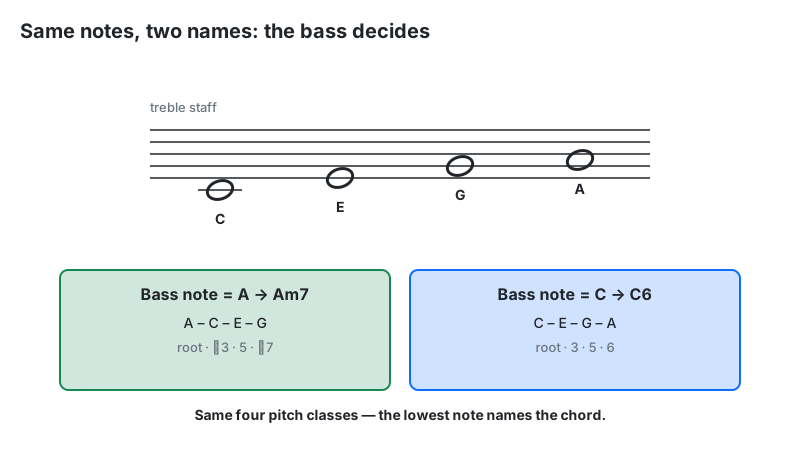
Chord names are interpretations, not facts — the most useful lesson a chord identifier teaches. C–E–G–B is Cmaj7 with C in the bass, while C–E–G–A is both Am7 (A–C–E–G) and C6 (C–E–G–A). Same four notes, two legitimate names, different harmonic functions.
Choose between alternative readings in 3 steps. First, check the bass note: A in the bass points to Am7; C points to C6. Second, check where the chord resolves: motion toward D minor favors Am7; motion toward F favors C6. Third, check for missing tones: prefer the name that needs fewer invented notes. Then use the interval calculator to double-check any single interval you are unsure about.
Symmetrical chords multiply the effect. A diminished seventh chord divides the octave into equal minor thirds, so B–D–F–G♯ returns four equally valid names — Bdim7, Ddim7, Fdim7, and G♯dim7. An augmented triad does the same in major thirds, returning 3 readings (Caug, Eaug, G♯aug). With symmetrical sets no reading outranks another; only the key and the bass line break the tie.
Inversions: The Bass Note Changes Everything
An inversion is the same chord with a different note in the bass. C–E–G with C lowest is root position; E lowest is first inversion (C/E); G lowest is second inversion (C/G). The chord's identity holds, but stability shifts — second-inversion triads sound restless and pull toward resolution, which is why composers place them at cadences.
This identifier does not label inversions. Its note buttons are pitch classes with no octave and no bass, so every arrangement of C–E–G returns the same root-position name. Read your own inversion from the note your left hand or bass player sounds lowest: root in the bass means root position, the 3rd means first inversion, the 5th means second inversion — and in a seventh chord, the 7th in the bass means third inversion.
From a Chord to a Full Progression
A named chord is a starting point — progressions are the destination. Once the identifier names your voicing, take its root and quality into the chord progression generator: a Cmaj7 discovery becomes the I chord of a I–vi–ii–V in C, and the generator shows you the diatonic companions that will make it sound intentional rather than accidental.
Producers use this loop constantly: hum a voicing into a piano roll, identify it, generate three progressions around it, and pick the one whose emotional arc fits the track. Theory serves the ear — never the reverse.
Limitations
- Needs at least 3 notes. Two notes make an interval, not a chord — use the interval calculator for dyads.
- 15 of the 16 templates can match. The library holds 16 entries — triads, seventh chords, sixth chords, and add9 — but the add9 entry stores its top interval at 14 semitones while the matcher folds intervals into one octave (mod 12), so it can never fire. Voicings containing a 9th, 11th, or 13th return no match, and any selection of 5 or more pitch classes matches nothing at all.
- No inversion or slash-chord labels. Input is a set of pitch classes — no octaves, no bass note — so the result is always the root-position name. Determine the inversion from your own lowest note (see Inversions above).
- Voicing-blind. Doublings, spacing, and octave placement are invisible to the matcher: a close-position triad and the same notes spread across three octaves return identical results.
- 12-tone equal temperament assumed. Microtonal or just-intonation voicings round to the nearest semitone template.
- Context-free naming. The tool names the pitch set, not its function in your song — Am7 vs C6 stays your call.
- Cluster voicings may match nothing. Dense chromatic clusters (e.g. C–C♯–D) have no standard chord name, and the tool says so honestly.
Chord Identifier vs Alternatives
| Method | How it works | Best for | Watch out for |
|---|---|---|---|
| This tool | Note input → template matching, all roots tested | Quick naming, formulas, alternative readings | No inversion labels; context-free — you pick the final name |
| Chord dictionary book/app | Look up shapes by name | Learning standard voicings | One direction only (name → notes) |
| DAW chord track | Analyzes MIDI in your project | Chords already in a session | Tied to one DAW; naming varies |
| Teacher / forum | Human analysis | Ambiguous jazz voicings | Slow; answers vary by theorist |