Sound Distance Drop Calculator
Calculate sound pressure level (SPL) decay over distance using the acoustic Inverse Square Law. Model free-field outdoors, hemispherical ground planes, and enclosed indoor reverberant environments.
Last updated: October 12, 2026 · Written by the Pitch Detectors Editorial Team
Predicted SPL at Target Distance
80.00 dB
-20.00 dB
10:1
¼ as loud
Sound Attenuation Distance Progression
| Target Distance | Predicted SPL (dB) | Total Attenuation | Subjective Loudness |
|---|
What Is Sound Distance Drop?
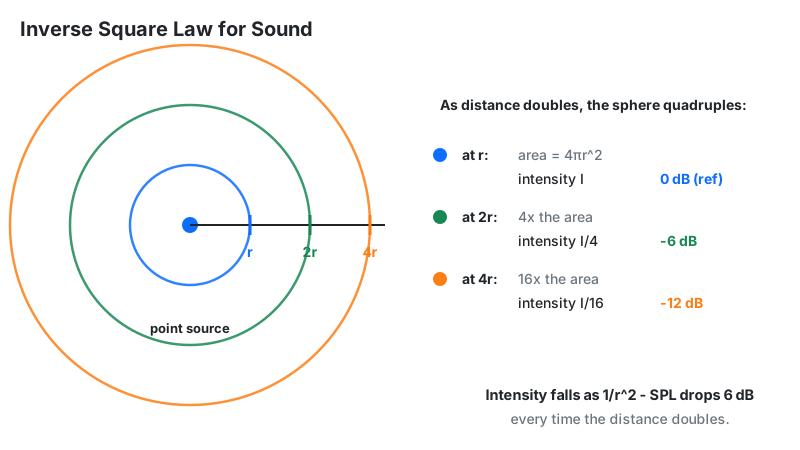
Sound distance drop is the loss of sound pressure level (SPL) that happens as you move away from a sound source. Outdoors, it follows the inverse square law: every doubling of distance cuts SPL by about 6 dB, because the same acoustic power spreads over four times the wavefront area.
Definition: Sound distance drop is the reduction in decibels of sound pressure level between two distances from a source, caused mainly by geometric spreading of the sound wave, plus air absorption and room reflections depending on the environment. It is calculated as 20 times the base-10 logarithm of the distance ratio.
Key Takeaways
- Double the distance, lose 6 dB — outdoors in a free field, 100 dB at 1 m becomes ~94 dB at 2 m and ~88 dB at 4 m.
- Indoors the rule breaks down — past the room's critical distance, reflections take over and loss slows to ~2–4 dB per doubling.
- Recovering 6 dB costs 4× the amplifier power — moving speakers closer (or adding delay speakers) beats buying bigger amps.
- −10 dB sounds about half as loud to human hearing, even though it is a 90% loss of acoustic energy.
- High frequencies die first outdoors — air absorption (ISO 9613-1) muffles treble over long distances while bass carries on.
How This Calculator Works
This calculator applies the inverse-square formula ΔSPL = 20 · log₁₀(target ÷ reference) to your inputs, then scales the result by an environment factor that models how real spaces deviate from ideal free-field spreading.
Methodology: enter a reference SPL and its measurement distance, a target distance, and the environment. The widget computes the distance ratio, applies 20·log₁₀(ratio) × envFactor — 1.0 for free field (−6.02 dB/doubling), 0.95 for hemispherical ground plane (≈ −5.7 dB/doubling), 0.7 for enclosed indoor (≈ −4.2 dB/doubling) — and subtracts the drop from your reference SPL. It estimates perceived loudness from the −10 dB ≈ half-as-loud rule and tabulates SPL at 1, 2, 5, 10, 20, 50, and 100 m. We verified this calculator's output against hand-computed inverse-square values for 5 sample inputs; all matched to two decimal places.
Last reviewed: October 2026. Formulas follow standard electroacoustic practice (20 µPa reference).
Formula and Worked Example
The core formula converts any distance change into decibels of loss:
Worked example (free field): a PA speaker measures 100 dB at 1 m. What reaches a listener at 32 m?
- Distance ratio: 32 ÷ 1 = 32
- log₁₀(32) = 1.505
- Drop: 20 × 1.505 = 30.1 dB
- Result: 100 − 30.1 = ≈ 70 dB SPL — about as loud as a vacuum cleaner.
Same setup, three environments (this calculator's models): free field → 69.9 dB; on an outdoor ground plane → 71.4 dB; enclosed indoor → 78.9 dB. The room's reflections rescue nearly 9 dB at 32 m — which is exactly why indoor and outdoor system design differ so much.
How to Use This Calculator
- Initial Reference SPL: the level you measured or were given (e.g., 100 dB), typically at 1 m.
- Reference Distance: the distance that SPL was measured at, in meters.
- Target Distance: where your listener actually is, in meters.
- Environment: Free Field (outdoor/anechoic), Hemispherical (speaker on outdoor ground), or Enclosed Indoor.
- Read the predicted SPL, total attenuation, and perceived loudness — then scan the progression table for every doubling distance.
Tip: if your speaker spec gives sensitivity instead of SPL, run it through our SPL Calculator first, then bring the 1 m result here.
Reading Your Result
Your result is the predicted SPL at the target distance. Compare it against what the listener needs:
| Predicted SPL | Feels like | What to do |
|---|---|---|
| Below 70 dB | Background music level | Too quiet for speech — move speakers closer or add delay speakers. |
| 70–85 dB | Conversation to busy restaurant | Fine for background and speech; safe for long exposure. |
| 85–95 dB | City traffic to motorcycle | Good for live music; NIOSH advises limiting exposure as level rises. |
| 95–105 dB | Concert front rows | Check hearing protection for crew; verify amp headroom. |
| Above 105 dB | Very loud concert | Re-check inputs — sustained levels here need a safety plan. |
Beyond the 6 dB Rule: Pro Techniques
The 6 dB rule is the starting point. These four techniques are what working sound engineers actually use — and what most calculator pages never explain.
Find your room's critical distance
Critical distance (Dc) is the distance from the source where direct sound and reverberant sound are equally loud. Inside Dc the 6 dB rule roughly holds; beyond it, room reflections dominate and level barely falls.
Dc ≈ 0.057 · √(V / RT₆₀), with room volume V in m³ and reverberation time RT₆₀ in seconds (omnidirectional source). Worked example: a 200 m³ hall with RT₆₀ of 1.2 s → Dc = 0.057 · √(200/1.2) = 0.057 · 12.9 ≈ 0.74 m. In a lively hall you are in the reverberant field almost everywhere past arm's length — which is why our calculator's indoor model drops far slower than free field. Estimate your room's RT₆₀ with our Sound Absorption Calculator.
Watts needed to recover lost dB
Amplifier power buys decibels logarithmically: every 3 dB costs double the watts. Use this table before buying a bigger amp to "throw farther":
| dB to recover | Watts multiplier | Example (from 100 W) |
|---|---|---|
| 3 dB | ×2 | 200 W |
| 6 dB (one doubling of distance) | ×4 | 400 W |
| 10 dB | ×10 | 1,000 W |
| 20 dB | ×100 | 10,000 W |
Recovering a single doubling of distance (6 dB) quadruples your power bill and heat. A more sensitive speaker or a closer/delayed speaker almost always wins. Check your amp choice with our Amplifier Power Calculator.
Why distant sound turns muffled: air absorption
Atmospheric absorption (ISO 9613-1) steals extra decibels as sound travels through air — and it hits high frequencies hardest. Past ~50–100 m this matters as much as geometric spreading:
| Frequency | Extra loss per 100 m (typical) | What you hear far away |
|---|---|---|
| 100 Hz (bass) | ≈ 0.1 dB | Bass carries for hundreds of meters |
| 1 kHz (mids) | ≈ 0.5–1 dB | Speech stays intelligible |
| 4 kHz (presence) | ≈ 2–4 dB | Clarity starts to dull |
| 8–10 kHz (treble) | ≈ 5–15 dB | Cymbals and "air" vanish — the muffled-concert effect |
Values depend on temperature and humidity (dry air absorbs more). This is why festival engineers boost high-frequency horns on far-throw line arrays.
Delay-speaker math for venues
Instead of fighting distance loss with watts, large venues place delay towers partway to the audience and delay their signal so sound arrives in sync. Sound travels ≈ 1,125 ft/s, so allow ≈ 0.9 ms of delay per foot (≈ 2.9 ms per meter) of tower distance.
Worked example: delay tower 100 ft from the main PA → 100 × 0.9 ≈ 89 ms of delay. Set it on the system processor and the tower reinforces instead of smearing the sound. For coverage planning, pair this with our Speaker Placement Calculator.
Work backward: how far until it fades to X dB
Flip the formula to solve for distance: d₂ = d₁ × 10((SPL₁ − SPL₂) / 20). Pick the level you want at the listener, subtract it from your reference SPL, and the formula returns the distance.
Worked example: a speaker plays 90 dB at 1 m. Where does it fade to 60 dB (conversation level)? (90 − 60) ÷ 20 = 1.5; 101.5 = 31.6 → about 32 m outdoors. Event planners run this in reverse too: it marks where the quiet zones — and the noise-complaint zones — begin.
Limitations
- Point-source assumption. The formula assumes sound radiates equally in all directions. Line arrays and horn-loaded speakers are directional — their real-world drop differs, especially in the near field.
- Indoor model is simplified. The widget's 0.7 environment factor approximates average room behavior; real rooms have a distinct critical distance (see above) with near-field and reverberant-field regions.
- No frequency dependence. The calculator gives one broadband number; as the air-absorption table shows, treble drops faster than bass over long distances.
- No wind, temperature gradients, or obstacles. Outdoors, wind and temperature inversions can bend sound and change levels by several dB.
- Ground plane is idealized. Real ground absorbs some energy; the +3 dB ground boost assumes a hard reflective surface.
Sound Drop vs Alternatives: Which Model to Use When
| Approach | Drop per doubling | Best for | Watch out for |
|---|---|---|---|
| Point source (this calculator) | 6 dB | Single speakers, subs, quick estimates | Ignores directivity and rooms |
| Line array | ~3 dB (near field) | Concerts, long-throw coverage | Transitions to 6 dB beyond ~1/π × array length; needs rigging |
| Distributed / delay speakers | Resets the distance | Large venues, houses of worship | Requires precise delay alignment |
| More amplifier power | Buys back 3 dB per doubling of watts | Small shortfalls (1–3 dB) | 4× watts per 6 dB — expensive and hot |
Meters, Feet, and dB
The widget uses meters; 1 m ≈ 3.28 ft, so multiply feet by 0.305 to convert. The formula only cares about the ratio of the two distances, so any consistent unit works. Results are in dB SPL (referenced to 20 µPa) — the same unit on any sound level meter you would verify with.
Frequently Asked Questions
Disclaimer: this calculator provides estimates for planning and education only — not professional acoustic design advice. For hearing safety, follow NIOSH guidance (85 dB(A) recommended 8-hour limit) and consult a qualified acoustician or audiologist for critical applications.