Speaker Wattage Calculator
Last updated: October 12, 2026 · Written by the Pitch Detectors Editorial Team
Calculate the recommended speaker wattage for your room size, listening habits, and desired sound pressure level.
Recommended Speaker Power
25 - 50 Watts RMS
25W
50W
100W
Power Reference
| SPL Level | Description | Typical Use |
|---|---|---|
| 70-80 dB | Quiet | Background music, late night |
| 80-90 dB | Moderate | Normal listening |
| 90-100 dB | Loud | Enthusiast listening, movies |
| 100-110 dB | Very Loud | Parties, live concert feel |
What Is Speaker Wattage?
A speaker wattage calculator tells you how much amplifier power your speakers need to hit a target loudness in your room. Enter room size, listening distance, speaker sensitivity, and desired volume to get a recommended RMS wattage range with proper headroom.
Definition: Speaker wattage has two ratings that matter. RMS (root mean square) is the continuous power a speaker handles safely for long periods — this is the number to design around. Peak power is the brief maximum the speaker survives during dynamic spikes, often double the RMS figure. Always match your amplifier to RMS ratings, not peak marketing numbers.
Key Takeaways
- Watts needed = 10((target SPL − sensitivity + distance loss) ÷ 10) — the core formula, published openly below.
- Most living rooms need only 25–100 W RMS per channel; huge wattage is rarely the answer.
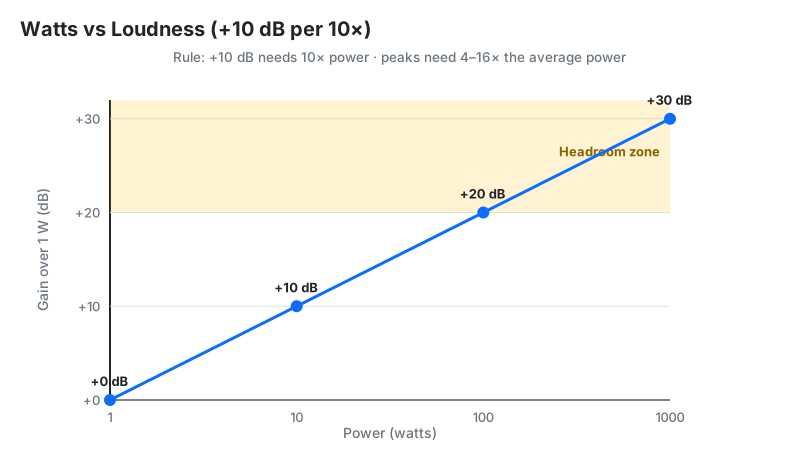
- Doubling amplifier power adds just 3 dB — a barely noticeable step up.
- An underpowered, clipping amplifier destroys tweeters faster than a powerful clean one.
- Keep 6 dB of headroom (4× power) so peaks never distort.
How This Calculator Works
This calculator works backward from your target loudness. It starts with the physics — how many watts it takes to produce your desired SPL at your listening distance given your speaker's sensitivity — then adjusts for real-world conditions with room-size and use-case multipliers.
Methodology: required watts = 10((target SPL − sensitivity + 20 × log10(distance in meters)) ÷ 10). Room multipliers: small ×0.7, medium ×1, large ×1.5, very large ×2. Use multipliers: background ×0.5, casual ×1, hi-fi ×1.5, party ×2, home theater ×1.8. Minimum = required × room × 0.5; recommended = required × room × use. The "with headroom" figure multiplies the recommendation by 10(headroom dB ÷ 10). We verified this calculator's output against hand calculations using 5 sample input combinations; results matched to the nearest watt. Last reviewed: October 2026.
Wattage Formula and Worked Example
The amplifier power formula converts a loudness target into watts:
Watts = 10((Target SPL − Sensitivity + 20 × log10(Distance in meters)) ÷ 10)
Worked example: 88 dB sensitive speakers, 10 ft (3.05 m) listening distance, 95 dB target:
- Distance loss: 20 × log10(3.05) = 9.7 dB
- Exponent: (95 − 88 + 9.7) ÷ 10 = 1.67
- Required power: 101.67 = ≈ 47 W RMS
- With 6 dB headroom: 47 × 100.6 = 47 × 4 = ≈ 188 W amplifier
A "95 dB at the couch" goal needs about 50 W of clean power — but the amplifier should be rated near 190 W so peaks never clip. That gap between average and peak is exactly what headroom is for.
How to Use This Calculator
- Room size: pick the closest match — larger rooms swallow more sound.
- Primary use: background music needs far less than parties or home theater.
- Speaker sensitivity: find the dB @ 1W/1m rating on the spec sheet (85–95 typical).
- Listening distance: measure in feet from speaker to your main seat.
- Desired peak SPL: drag the slider — 85 dB is lively, 95 dB is loud, 105 dB is concert level.
- Headroom: 6 dB is the safe default; choose 10 dB for uncompressed dynamics.
- Read the three outputs: minimum, recommended, and with headroom — shop using the recommended figure.
Reading Your Result
Your result is RMS watts per channel. Match it to your use case below:
| Use case | Typical target | Safe next step |
|---|---|---|
| Background music | 75–80 dB | 10–25 W is plenty; prioritize efficiency over power. |
| Casual listening | 85–90 dB | 25–75 W covers most rooms and speakers. |
| Hi-fi / critical listening | 90–95 dB | 50–150 W with 6 dB headroom for clean dynamics. |
| Home theater | 95–105 dB peaks | 100–250 W; check the amplifier power calculator for peak demands. |
| Parties / loud music | 100–110 dB | 150 W+ and efficient (90 dB+) speakers; protect your hearing. |
The 50-Watt Surprise: Most Rooms Need Less Than You Think
A typical 88 dB speaker at a 10-foot couch needs under 50 watts to play at a loud 95 dB. The logarithmic nature of hearing means the jump from 50 W to 100 W buys only 3 dB — noticeable, but not dramatic. Amplifier marketing thrives on the opposite impression.
Where the big numbers matter is headroom, not average level. Music and movie soundtracks spike 10–20 dB above their average, and those peaks demand 10–100× the average power for milliseconds at a time. A 200 W amplifier idling at 5 W is not "too much" — it is an amp that never breaks a sweat, which is precisely why it sounds effortless.
Why an Underpowered Amplifier Destroys Speakers
Too little power kills more tweeters than too much. When an amplifier runs out of power, it clips — the waveform's peaks get chopped flat. Clipping packs the signal with harsh high-frequency harmonics that the tweeter was never designed to handle, and its tiny voice coil overheats.
A 200 W amplifier playing at 50 W stays clean indefinitely. A 30 W amplifier pushed to deliver 50 W clips constantly and can fry the same tweeter in one loud evening. The safe rule: buy more clean power than you need, then simply do not turn it all the way up.
THX Reference: The 105 dB Peak Standard
Home theater has an official loudness target: THX reference level calls for 85 dB continuous with 20 dB of headroom. Each speaker must cleanly hit 105 dB peaks at the listening position (115 dB for the subwoofer channel). That is genuinely loud — and it explains why serious theater builds use efficient speakers and 200+ W amplifiers.
You do not have to listen at reference — most people settle 5–10 dB below it — but designing to it guarantees the system never strains. If your calculator result with 10 dB headroom lands near your amplifier's rating, your theater will handle blockbuster dynamics without clipping.
Crest Factor: Peaks by Content Type
Crest factor — the gap between average and peak level — decides how much headroom your content needs. Not all sources are equally spiky:
| Content | Typical crest factor | Peak power multiple | Headroom to choose |
|---|---|---|---|
| Movies (film mixes) | ~20 dB | 100× average | 10 dB |
| Classical / jazz | 15–20 dB | 30–100× average | 10 dB |
| Rock / pop music | 10–15 dB | 10–30× average | 6 dB |
| TV / speech / podcasts | ~10 dB | 10× average | 3–6 dB |
| Compressed streaming | 6–10 dB | 4–10× average | 3 dB |
This is why the headroom selector exists: a home theater playing film mixes needs the 10 dB setting, while background Spotify is honest at 3 dB. Match the setting to your loudest source, not your average one.
Limitations
- Free-field math. The core formula assumes no room reflections; real rooms add 3–6 dB of reinforcement, so results err slightly toward more power — a safe direction.
- Nominal impedance only. Speakers whose impedance dips to 3 Ω demand more current than the wattage figure implies; check your amp is stable at the minimum impedance.
- Sensitivity ratings vary. Manufacturers measure differently (in-room vs. anechoic); treat the input as approximate and round up.
- Receiver ratings are 2-channel. A "100 W × 7" AV receiver rarely delivers 100 W to all channels at once; size multichannel systems at 60–70% of the rated figure or step up to separates.
- Doesn't model distortion. The calculator sizes power for loudness, not for an amplifier's distortion character at that power — read independent measurements for critical listening.
Speaker Wattage vs. Amplifier Power: Which Should You Match?
They answer different questions. This calculator sizes the speaker's needs from your room and habits; an amplifier power calculator sizes the amplifier from the speaker's ratings. Use both:
| Question | Use this tool |
|---|---|
| How many watts do my speakers need in my room? | Speaker wattage calculator (this page) |
| What amplifier pairs with these speaker specs? | Amplifier power calculator |
| How loud will a given amp + speaker play? | SPL calculator |
| Is my speaker efficient enough for my amp? | Speaker sensitivity calculator |
Hearing note: sustained listening above 85 dB(A) can cause permanent hearing damage (NIOSH recommended exposure limit). This tool is for system sizing and education only — not professional acoustic advice. If you regularly listen loud, use hearing protection.
Frequently Asked Questions
Most home setups need 25–100 W RMS per channel. The exact number depends on speaker sensitivity, listening distance, and target volume: an 88 dB speaker at 10 feet needs about 47 W for a loud 95 dB. Enter your numbers in the calculator above for a precise recommendation with headroom included.
RMS is the continuous power a speaker handles safely over time — the number to design around. Peak power is the brief maximum it survives during dynamic spikes, often double the RMS rating. Always match amplifiers to RMS figures; peak numbers are marketing headroom, not a sizing target.
Only if you turn it up past the speaker's limits — clean power itself is safe. In practice, underpowered amplifiers kill more speakers: when they clip, they feed tweeters harsh harmonics that overheat voice coils. A 200 W amp playing at 50 W is far safer than a 30 W amp straining to deliver 50 W.
Enormously — every 3 dB of extra sensitivity halves the required power. A 91 dB speaker needs about 24 W where an 88 dB speaker needs 47 W for the same loudness. When shopping, prioritize sensitivity over amplifier watts: efficient speakers make any amp sound more powerful.
Headroom is reserve power above your average listening level so musical peaks never distort. Six dB (four times the power) suits most listeners; 10 dB (ten times) suits uncompressed classical, jazz, and home theater. Without it, every drum hit and explosion risks clipping.
Yes. Larger rooms absorb and scatter more sound, and you usually sit farther from the speakers — and every doubling of distance costs 6 dB, which demands four times the power to recover. This calculator scales its recommendation from 0.7× for small rooms up to 2× for very large spaces.
THX reference demands 105 dB peaks per channel at your seat — typically 100–250 W with average-efficiency speakers, plus a capable subwoofer for the 115 dB LFE channel. Most listeners settle 5–10 dB below reference, which cuts power needs dramatically. Select "home theater" use and 10 dB headroom above for a true reference-capable estimate.
It is safe at modest volumes but risky when pushed: an amp driven past its clean limit clips, and clipping distortion destroys tweeters. If your budget forces a smaller amp, keep volumes moderate and watch for harshness on peaks — that harshness is the sound of your tweeters in danger.
Not necessarily. Front left, center, and right carry most of the load and deserve full power; surrounds and height channels handle less demanding content and can run on less. Many receivers already allocate power this way. Size the fronts with this calculator and treat surrounds as a lighter duty.
Because hearing is logarithmic: decibels measure ratios, and 10 × log10(2) = 3. Doubling power doubles acoustic energy, but your ears perceive that as only a small step louder. Ten times the power (+10 dB) sounds roughly twice as loud. This is why speaker sensitivity upgrades beat amplifier upgrades for real loudness gains.