Room Acoustics Calculator
Last updated: October 18, 2026 · Written by the Pitch Detectors Editorial Team
A room acoustics calculator estimates your room's reverberation time (RT60), lists its first axial standing-wave modes, and tells you what treatment to add first. Enter length, width, height, surface condition, and use case — this tool returns RT60, the nine most important bass frequencies, and recommendations ranked by impact per dollar.
Key Takeaways
- RT60 = 0.161 × V / A (Sabine, metric) — volume divided by total absorption sets decay time.
- Axial modes: f = c / 2L — the first three per dimension cause most small-room bass problems.
- Target RT60: 0.2–0.4 s mixing, 0.3–0.5 s listening, 0.4–0.6 s recording and home theater.
- To halve your RT60 you must double total absorption — a worked panel budget is below.
- Below the Schroeder frequency (~150–250 Hz in small rooms), modes rule — treat bass, not reverb.
What Is Room Acoustics?
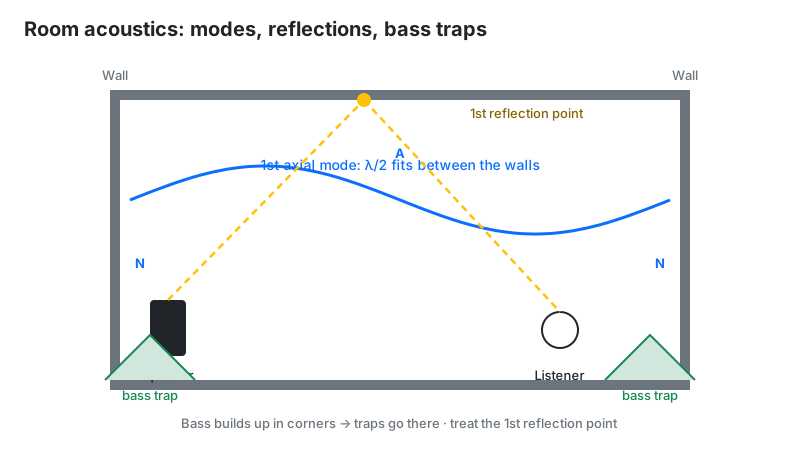
In small rooms — studios, bedrooms, home theaters — the modes matter more than the reverb. A 15-foot room has its first length mode near 38 Hz; play a bass note there and the room amplifies it, while a note between modes nearly disappears. Move your head a foot and the bass changes completely. No equalizer fully fixes modal behavior — only treatment and placement do.
RT60 describes the statistical wash of reflections above the modal region. Too long and speech smears; too short and the room sounds unnaturally dead. Different uses want different targets, and this calculator compares your room against each one.
How This Calculator Works
This calculator combines two classic acoustic models from your room dimensions. It computes the first three axial modes per dimension, estimates RT60 with the Sabine formula using a preset average absorption for your surface condition, then compares the result against your use case's target range to generate treatment recommendations.
Methodology: axial modes via f = c / 2L (c = 1125 ft/s), giving f1, f2, f3 per dimension. RT60 via Sabine: RT60 = 0.161 × V / A with metric volume and total absorption A = surface-area × α, where α = 0.05 (bare), 0.15 (furnished), or 0.35 (treated). We verified the widget's mode frequencies and RT60 against hand calculations for 5 room sizes (10×12×8 ft through 25×18×10 ft); all match to the displayed precision.
Formula + Worked Example
RT60 = 0.161 × V / A · fn = n × c / 2L
V in m³, A in metric sabins · c = 343 m/s (1125 ft/s) · n = 1, 2, 3…
Worked example: room 20 × 15 × 9 ft, furnished (α = 0.15):
- Volume: 20 × 15 × 9 = 2,700 ft³ = 76.5 m³.
- Surface: 2(20×15 + 20×9 + 15×9) = 2(300 + 180 + 135) = 1,230 ft² = 114.3 m².
- Absorption: A = 114.3 × 0.15 = 17.1 sabins.
- RT60 = 0.161 × 76.5 / 17.1 = 0.72 s — too live for mixing (target 0.2–0.4 s); this room needs treatment.
- First length mode: f1 = 1125 / (2 × 20) = 28.1 Hz; f2 = 56.3 Hz; f3 = 84.4 Hz.
How to Use This Calculator
- Room dimensionsEnter length, width, and height in feet. Measure wall to wall; include closets only if their doors stay open.
- Boundary surface conditionBare (drywall/concrete), furnished (typical living room), or treated (existing panels). This sets the absorption preset.
- Target use caseListening, mixing, recording, or home theater — each has its own ideal RT60 window.
- Read the mode tableCheck whether any two modes land within a few Hz of each other — stacked modes boom twice as hard.
- Follow the recommendationsThe treatment box tells you what to add first, ranked by impact per dollar.
Reading Your Result
| Use case | Ideal RT60 | Your RT60 is higher → | Your RT60 is lower → |
|---|---|---|---|
| Mixing / mastering | 0.2–0.4 s | Add broadband panels + bass traps; mixes won't translate | Rare — enjoy the accuracy |
| Critical listening | 0.3–0.5 s | Treat first reflections + corners | Add diffusion to restore life |
| Recording | 0.3–0.6 s | Panels at reflection points; vocals smear otherwise | Fine for dry vocal booths |
| Home theater | 0.4–0.6 s | Dialogue clarity suffers; treat front half | Acceptable — envelopment comes from speakers |
How Many Sabins You Actually Need
RT60 targets convert directly into a shopping list. Work backwards: the absorption your target requires is A_needed = 0.161 × V / RT60_target — subtract what you already have, and the remainder is what you must buy.
Worked budget on the example room (76.5 m³, furnished, existing A = 17.1 sabins), targeting 0.4 s for mixing-adjacent listening:
- A_needed = 0.161 × 76.5 / 0.4 = 30.8 sabins.
- To add: 30.8 − 17.1 = 13.7 sabins.
- With α = 0.9 panels: 13.7 / 0.9 ≈ 15.2 m² of panel — about 164 ft², or roughly ten 2×4 ft panels.
Remember the doubling rule: to halve your RT60, you must double total absorption. Buy panels rated with full frequency data (not just NRC), and subtract absorption you already own — carpet, curtains, and bookshelves count.
Schroeder Frequency: Where Modes Stop and Reverb Starts
Below roughly 2000 × √(RT60 / V) Hz, your room is a collection of individual resonances; above it, reflections blur into statistical reverb. For the worked 76.5 m³ room at 0.72 s RT60: 2000 × √(0.72/76.5) ≈ 194 Hz.
This dividing line changes your treatment strategy completely. Below it, RT60 tweaks do almost nothing — you need bass traps targeting specific modal frequencies. Above it, absorption panels and diffusion control the decay. Most small-room complaints ("boomy bass", "boxy vocals") live below the Schroeder frequency, which is why foam panels alone never fix them.
The Mirror Trick for First Reflections
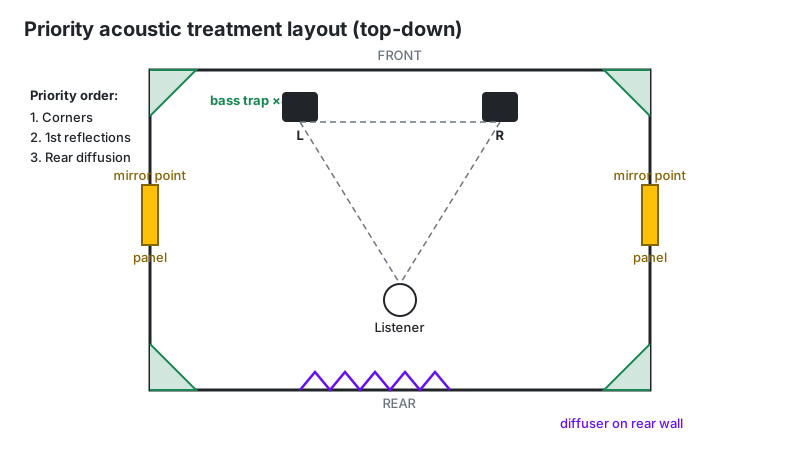
The most damaging reflections arrive within the first 20 ms — they comb-filter with the direct sound and smear imaging. Find them with the mirror trick: sit in your listening position, have a friend slide a mirror along each side wall, and mark every spot where you see a speaker in the mirror. Those are your first-reflection points.
Treat those spots with 2–4" broadband absorption. Do the same for the ceiling (a "cloud" panel above the mix position). This single step typically delivers the biggest audible improvement per dollar in any untreated room.
Flutter Echo: The Clap Test
Stand in the middle of your room and clap once, sharply. If you hear a metallic ringing tail — like a spring reverb — that's flutter echo: sound bouncing back and forth between parallel bare walls. It murders vocal clarity and stereo imaging.
Fix it by breaking the cycle: absorption on one of the two walls is enough (both is overkill), or add diffusion to scatter the reflections in time. Bookshelves full of uneven books are a surprisingly effective folk remedy — genuine diffusion, not absorption.
Room Ratios: Don't Build a Cube
When two room dimensions match — or one is a simple multiple of another — their modes stack at the same frequency and boom twice as hard. A 12×12×8 ft room is an acoustic disaster: length and width modes coincide at every harmonic.
Favored ratios spread modes evenly (Bolt's criteria). Classics include 1 : 1.26 : 1.59 and 1 : 1.6 : 2.33 (height : width : length). If you're stuck with bad ratios, the cure is the same as always: more bass trapping at the stacked frequencies, and never place your listening seat at a null.
Bass Traps: Why Corners, How Deep
Bass pressure is highest where room boundaries meet — corners, especially tri-corners where two walls meet the ceiling or floor. That's where traps absorb the most modal energy per square foot. A trap on a flat mid-room wall does a fraction of the work.
Depth follows the quarter-wavelength rule: porous absorption peaks where the material thickness (plus any air gap) reaches about a quarter wavelength. A 4" panel peaks near 850 Hz; straddling a corner with an 8" effective depth pushes that to ~420 Hz. The classic "superchunk" — a floor-to-ceiling triangle of insulation stuffed into the corner — wins on price per low-frequency sabin. The 1-inch foam squares sold as "bass traps" are not bass traps.
Absorption Coefficients: What's Actually Absorptive
Typical values at 500 Hz (speech range). One number never tells the whole story — real absorption falls off toward bass and rises toward treble:
| Material | α @ 500 Hz | Note |
|---|---|---|
| Concrete / brick | 0.02 | Essentially reflective |
| Drywall on studs | 0.05 | The widget's "bare" preset |
| Window glass | 0.04 | Reflective; heavy curtains help |
| Open doorway / window | ~1.0 | Sound leaves the room — counts as perfect absorption |
| Carpet on concrete | 0.3 | Highs only — no bass effect |
| Heavy curtains | 0.5 | Good broadband-ish absorber |
| 2" acoustic panel | 0.8 | Effective down to ~500 Hz |
| 4" bass trap | 1.0 | Effective down to ~125 Hz |
Sanity-check the widget's presets against this table: a "furnished" 0.15 average is plausible for a carpeted living room with curtains and a couch; a bare drywall box really is near 0.05. And remember that open doorway: a permanently open room behaves acoustically larger than its measured volume.
Limitations
- Axial modes only. Tangential and oblique modes exist too but are weaker; the widget lists the dominant three per dimension.
- Single-number RT60. Real RT60 varies with frequency — bass decays longer. The widget gives a mid-band estimate.
- Absorption presets are averages. Your actual α depends on furnishings; measure with a clap and an RTA app for ground truth.
- Sabine overestimates dead rooms. The "treated" preset (α = 0.35) pushes past the range where the Sabine formula is most accurate — the Eyring–Norris formula gives truer numbers for heavily treated rooms.
- Rectangular rooms assumed. L-shaped rooms, vaulted ceilings, and open floor plans break the simple models.
- No speaker/listener positions. Mode excitation depends on where the sub and your ears sit relative to nodes — the frequencies are fixed, the audibility isn't.
Absorption vs Diffusion: When to Use Which
| Absorption | Diffusion | |
|---|---|---|
| Does | Removes reflection energy | Scatters reflections in time/direction |
| Use at | First-reflection points, corners (bass) | Rear wall, large flat surfaces |
| Risk | Over-deadening; room sounds lifeless | Needs distance to work (≥6 ft from listener) |
| Rule | Treat problems first | Then diffuse what's left for envelopment |
Frequently Asked Questions
RT60 and mode estimates use standard textbook formulas for rectangular rooms. For critical builds, verify with an RTA measurement app and a calibrated microphone.