Room Mode Calculator
Last updated: October 18, 2026 · Written by the Pitch Detectors Editorial Team
A room mode calculator lists every standing-wave resonance your rectangular room supports up to a chosen cutoff frequency. Enter length, width, and height — this tool computes each mode's frequency from the room-mode formula, labels it axial, tangential, or oblique, and sorts the full list so clustered and coincident modes stand out.
Key Takeaways
- Room modes follow f = (c/2) × √((n/L)² + (m/W)² + (p/H)²), with c = 343 m/s at 20°C.
- Axial modes (one dimension) dominate; tangential run ~3 dB lower; oblique ~6 dB lower.
- EQ cuts peaks but cannot fix nulls — nulls are cancellation, not missing energy.
- The Bonello criterion checks modal smoothness: mode counts per third-octave band must never drop as frequency rises.
- Sit at ~38% of room length; place subs with the crawl method. Cubes and square rooms stack modes and boom hardest.
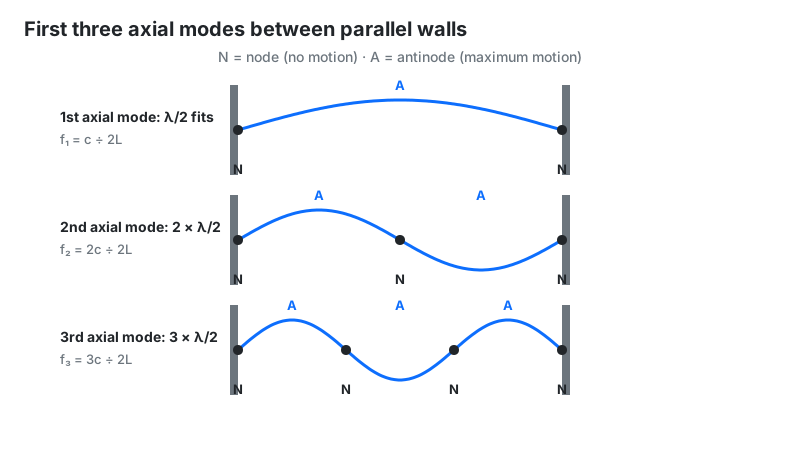
What Are Room Modes?
Play a frequency sweep in an untreated room and you hear it directly: some bass notes thunder, others vanish, and moving your head a foot flips the balance. The room itself is resonating at its own fixed frequencies — as fixed as the frets on a guitar. Your speakers excite these resonances; the walls sustain them.
Three families exist. Axial modes bounce between one pair of parallel walls and carry the most energy. Tangential modes involve two dimensions (four surfaces) and run about 3 dB quieter. Oblique modes touch all six surfaces and sit about 6 dB below axial. Every reflection steals energy, so fewer surfaces means a stronger mode.
How This Calculator Works
This calculator enumerates every mode tuple (n, m, p) with indices from 0 to 5 for your three room dimensions, skips the meaningless (0, 0, 0) tuple, computes each frequency, classifies it by how many indices are nonzero, discards anything above your cutoff, and sorts the survivors from lowest to highest. Dimensions are entered in meters; the speed of sound is fixed at 343 m/s (the value Room EQ Wizard uses as its default).
Methodology: f = (343/2) × √((n/L)² + (m/W)² + (p/H)²). Exactly one nonzero index → axial; two nonzero → tangential; three nonzero → oblique. Degenerate tuples that share one frequency are kept as separate rows, because each has its own pressure pattern in the room. We verified the widget's frequencies against hand calculations for 3 room sizes (including a 5×4×3 m reference room); every value matches to the displayed 0.1 Hz precision.
Formula + Worked Example
f = (c/2) × √((n/L)² + (m/W)² + (p/H)²)
c = 343 m/s (1125 ft/s) · L, W, H in the same unit · n, m, p = 0, 1, 2…
Worked example: room 5 × 4 × 3 m. Using meters, c/2 = 171.5:
- First length axial (n=1, m=0, p=0): 171.5 × √(1/5)² = 171.5 × 0.2 = 34.3 Hz.
- Second length harmonic (n=2): 171.5 × 0.4 = 68.6 Hz.
- First width axial (m=1): 171.5 × 0.25 = 42.9 Hz.
- Tangential (n=1, m=1): 171.5 × √(0.04 + 0.0625) = 171.5 × 0.320 = 54.9 Hz.
- Oblique (n=1, m=1, p=1): 171.5 × √(0.04 + 0.0625 + 0.111) = 171.5 × 0.462 = 79.3 Hz.
Notice 34.3 and 42.9 Hz sit only 8.6 Hz apart — a cluster that sounds like one boomy note. The sorted widget list exists to expose exactly these clusters.
Temperature correction: 343 m/s is not a constant
The speed of sound rises about 0.6 m/s per °C: c ≈ 331.3 + 0.606 × T(°C). At 20°C it is 343 m/s; at 30°C it is 349 m/s. A 10°C swing shifts a 100 Hz mode by roughly 1.8 Hz. This calculator (like most) fixes c at 343 m/s, so if your studio runs hot, expect real measured modes to land slightly above the listed frequencies. Temperature changes mode positions, not the room's problems.
How to Use This Calculator
- Length, Width, HeightRoom dimensions in meters (feet × 0.3048). Measure the clear inside distance, wall to wall.
- Max frequencyUpper cutoff in Hz — 300 Hz covers the modal region of most rooms. Above it, modes blur into statistical reverb.
- Scan the sorted listLook for clusters (modes within ~5 Hz) and coincident rows (identical frequencies, different tuples) — those are your problem notes.
- Run the Bonello checkCount modes per third-octave band going up; no band should hold fewer modes than the one below it (next section).
Reading Your Result
| What you see | What it means | What to do |
|---|---|---|
| Clustered modes (within ~5 Hz) | One big boomy note; long ringing | Bass-trap the corners; avoid boosting that region with EQ |
| Coincident modes (same Hz, different tuples) | Stacked resonance (degenerate) | Trap heavily at that frequency; change dimensions if still building |
| Sparse low end (gaps > 20 Hz) | Uneven bass; some notes missing | Add a subwoofer to excite more modes; reposition seating |
| Even, dense spacing | Smooth modal region | Nothing — your dimensions are good |
Axial vs Tangential vs Oblique: The Loudness Ladder
Not all modes hit equally hard. Each reflection steals energy, so the fewer surfaces involved, the stronger the mode:
| Type | Surfaces | Relative level | Matters most when |
|---|---|---|---|
| Axial | 2 (one dimension) | 0 dB (reference) | Always — these dominate small-room bass |
| Tangential | 4 (two dimensions) | ≈ −3 dB | Coinciding with an axial mode |
| Oblique | 6 (three dimensions) | ≈ −6 dB | Filling gaps between axials at higher frequencies |
Practical rule: treat axial modes first — bass traps in corners attack all three axial families at their pressure maxima. Tangential and oblique modes mostly take care of themselves once the axials are tamed.
Why Nulls Can't Be EQ'd (But Peaks Can)
A peak is too much energy — an EQ cut removes it cleanly. A null is wave cancellation: direct and reflected sound arrive out of phase and annihilate. Boosting a null with EQ drives the speaker harder into the same cancellation, wasting headroom and heating voice coils for zero audible gain.
This asymmetry is the single most misunderstood fact in room correction. DSP systems like Dirac Live, Audyssey, and REW-generated filters flatten peaks beautifully — but they share the same physics limit: a 20 dB null at your listening position is a placement problem, solved by moving the seat or the subwoofer, never by more EQ. Cut peaks with DSP; fix nulls by moving.
The Bonello Criterion: A Worked Check
The Bonello criterion is a smoothness test for small rooms: count the modes in each third-octave band going up in frequency — every band must contain at least as many modes as the band below it. A band that drops (fewer modes than its neighbor) is a smoothness gap that sounds uneven.
Worked check on the 5 × 4 × 3 m example room, counting the widget's modes from 34 Hz up:
| Third-octave band | Modes in band | Trend |
|---|---|---|
| 31.5 Hz | 1 (34.3) | baseline |
| 40 Hz | 1 (42.9) | steady |
| 50 Hz | 1 (54.9) | steady |
| 63 Hz | 3 (57.2, 66.7, 68.6) | rising ✓ |
| 80 Hz | 5 (71.5, 79.3, 80.9, 85.8, 89.3) | rising ✓ |
| 100 Hz | 7 (92.4–111.5) | rising ✓ |
| 125 Hz | 6 (114.3–137.2) | drops ✗ |
The 125 Hz band breaks the rule (6 modes after a band of 7) — expect slightly uneven response in the 115–140 Hz region. The fix is the same as always: bass trapping targeted at the modes in the thin band, plus seating placed off their nulls. No other free room-mode calculator walks you through this check step by step.
The 38% Rule and the Subwoofer Crawl
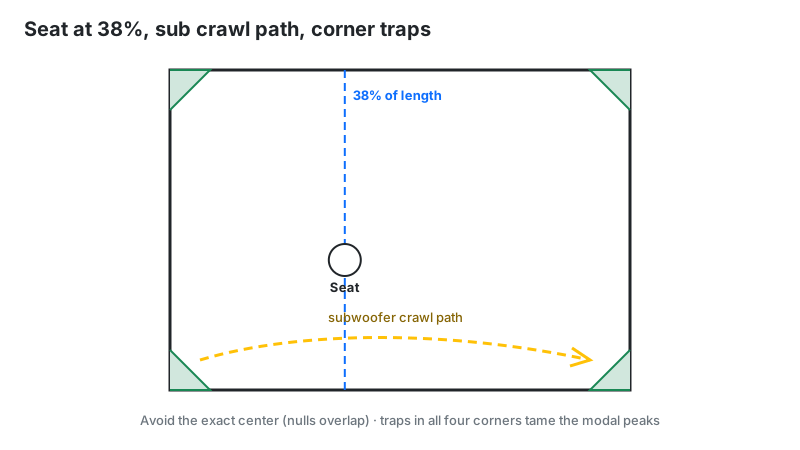
Seating: placing your ears at about 38% of the room's length from the front wall threads the needle between two bad spots — clear of the first axial null at the center (50%) and off the rear-wall pressure peak. It is a starting point, not gospel: the second harmonic's null sits at 33% and the first's at 50%, and 38% splits the difference. Verify with a measurement mic or a bass-heavy track you know well.
Subwoofer crawl: put the sub at your listening position, play a bass sweep, then crawl the room perimeter listening for where bass sounds most even — that's where the sub should live. It works because of reciprocity: the room's modal structure is identical with source and listener swapped. Corners excite the most modes (loudest); mid-wall excites the fewest (tightest).
Degenerate Modes: Why Cubes Are the Worst Room
When two dimensions match — a square room, or one dimension that's an exact multiple of another — their modes coincide at identical frequencies and add. A 4×4×3 m room stacks every length mode onto a width mode: the 85.8 Hz note carries double energy and rings twice as long, and the widget lists it as two separate degenerate rows at the same frequency.
This is why cubes are the universally worst listening-room shape, and why dimension ratios like 1 : 1.26 : 1.59 (Bolt's preferred ratios) exist: they spread coincidences apart. If you're stuck with a square room, the prescription is aggressive corner trapping at the stacked frequencies — no placement trick unstacks them.
Limitations
- Frequencies, not loudness. The formula predicts possible resonance frequencies — wall construction, damping, openings, speaker and listener position decide whether a mode shows up as a peak, a dip, or long decay.
- Rectangular rooms only. L-shapes, vaulted ceilings, and open plans need measurement or modeling software (REW Room Simulator handles speaker/listener positions too).
- Rigid-wall assumption. Real walls flex and leak bass, which lowers and broadens actual modes slightly.
- No furnishings. Heavy furniture and absorption damp modes — the widget shows the worst case.
- 343 m/s fixed. The real speed of sound shifts ~0.6 m/s per °C; temperature correction is above.
- Test-tone caution: if you verify modes with sine sweeps, start quiet and stop if listening becomes uncomfortable (WHO safe-listening guidance).
Room Modes vs Other Room Problems
| Problem | What it is | Frequency range | Fix |
|---|---|---|---|
| Room modes | Standing waves between surfaces | Below ~200–300 Hz | Bass traps, placement, Bonello check |
| SBIR | Speaker-boundary interference dip | 50–300 Hz | Move speakers vs front wall |
| Flutter echo | Bounce between parallel bare walls | Mids/highs | Absorb or diffuse one wall |
| Long RT60 | Slow overall decay | Above Schroeder freq. | Broadband absorption |
Frequently Asked Questions
Mode frequencies assume rigid rectangular boundaries and 343 m/s sound speed. Verify critical decisions with an in-room measurement (REW + calibrated mic).