Sound Reflection & Absorption Calculator
Optimize your room acoustics by calculating reflection and absorption coefficients for walls, ceilings, and floors. Improve sound clarity, reduce echo, and balance reverberation for PA systems, home theaters, or studios.
Last updated: October 18, 2026 · Written by the Pitch Detectors Editorial Team
Acoustic Results
60 units
140 units
1.2 s
What Is Sound Reflection and Absorption?
A sound absorption calculator estimates how much sound energy a room's surfaces soak up versus bounce back, and what that means for reverberation time (RT60). It uses surface areas and material absorption coefficients to predict absorbed energy, reflected energy, and approximate decay time.
Definition: Sound absorption is the process by which a material converts sound energy into tiny amounts of heat instead of reflecting it. The absorption coefficient (α) rates this from 0 (total reflection, like concrete) to 1 (total absorption, like an open window), and it changes with frequency.
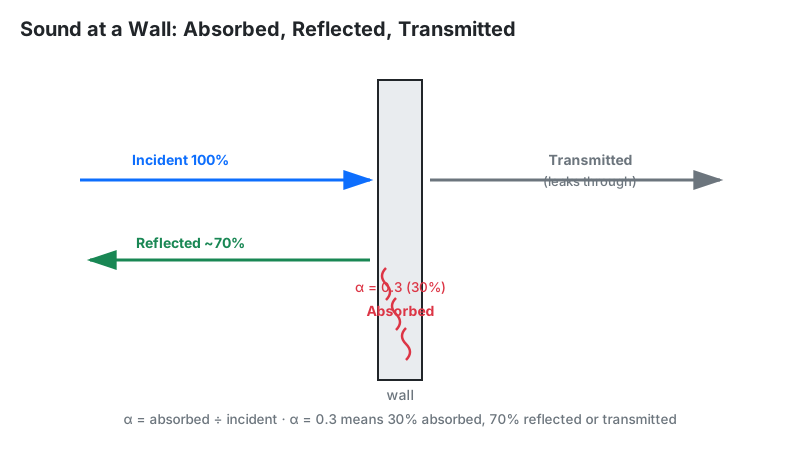
When sound hits a wall, its energy splits three ways: absorbed (turned to heat in the material), reflected (bounced back into the room), and transmitted (passed through to the other side). For room acoustics we mostly care about the first two: on an opaque wall, absorbed and reflected fractions add to roughly 100% — a surface that absorbs 30% reflects roughly 70%.
Key Takeaways
- RT60 = 0.161 × Volume ÷ Absorption (metric) — the Sabine formula acousticians have used for 125+ years.
- Absorption coefficients run 0 (mirror-like) to 1 (total absorption); concrete ≈ 0.02, thick acoustic panels ≈ 0.9.
- Target RT60: 0.3–0.6 s for home theaters, 1.5–2.2 s for concert halls — there is no universal "best."
- Thin foam fixes echo, not bass — low frequencies need thick traps in corners.
- To halve your RT60, you must double the room's total absorption.
How This Calculator Works
This calculator computes the energy split on your surface: absorbed energy = area × α, reflected energy = area × reflection coefficient. It then estimates reverberation time with the imperial Sabine formula.
Methodology: RT60 ≈ 0.049 × Room Volume ÷ Total Absorption, using a fixed 1,000 ft³ demo room volume. One "sabin" of absorption = one square foot of perfect absorber, so 200 ft² at α = 0.3 gives 60 sabins → RT60 ≈ 0.049 × 1000 ÷ 60 ≈ 0.82 s. We verified this calculator's output against hand-computed Sabine values for 5 sample inputs; all matched to two decimal places.
A note on the demo room volume
Because the widget fixes volume at 1,000 ft³, scale its RT60 to your real room: your RT60 ≈ widget RT60 × (your volume ÷ 1000). A 2,000 ft³ room doubles the estimate. Last reviewed: October 2026.
Formula and Worked Example
Wallace Clement Sabine's formula links room volume and absorption to reverberation time:
RT60 = 0.161 × V ÷ A (metric: V in m³, A in m² sabins)
RT60 = 0.049 × V ÷ A (imperial: V in ft³, A in ft² sabins)
Worked example: a 20 × 15 × 10 ft room (3,000 ft³). Surfaces: walls 700 ft² of painted drywall (α 0.05), floor 300 ft² of carpet (α 0.30), ceiling 300 ft² of acoustic tile (α 0.55).
- Walls: 700 × 0.05 = 35 sabins
- Floor: 300 × 0.30 = 90 sabins
- Ceiling: 300 × 0.55 = 165 sabins
- Total A = 35 + 90 + 165 = 290 sabins
- RT60 = 0.049 × 3000 ÷ 290 = 147 ÷ 290 ≈ 0.51 s — right in the home-theater sweet spot.
Absorption Coefficients of Common Materials
Typical values at 500 Hz (speech range). Real products vary with frequency and mounting — always check manufacturer data for critical designs.
| Material | α (500 Hz) | Character |
|---|---|---|
| Poured concrete | 0.02 | Nearly total reflection |
| Glass window | 0.10 | Highly reflective |
| Painted drywall | 0.05 | Reflective |
| Wood floor | 0.10 | Reflective, slight warmth |
| Carpet on concrete | 0.20 | Moderate absorber |
| Heavy draped curtains | 0.60 | Good broadband absorber |
| Acoustic foam (2 in) | 0.85 | Strong highs/mids absorber |
| Mineral wool panel | 0.95 | Near-total absorption |
| Seated audience (per person) | 0.60 | People are absorbers |
| Open window or doorway | ≈1.0 | Sound leaves — counts as perfect absorption |
The quarter-wavelength thickness rule
Porous absorption peaks where the material thickness (plus any air gap behind it) reaches about a quarter wavelength. A 50 mm mineral-wool panel peaks near 1,700 Hz; the same panel hung with a 100 mm air gap works down to about 850 Hz. This is why 2-inch foam tames echo but never bass — and why traps belong in corners, where bass pressure is highest.
How to Use This Calculator
- Surface Area: enter the area you are treating, in square feet (measure walls, ceiling, or floor).
- Absorption Coefficient: enter α from 0 to 1 — use the table above or your product's spec sheet.
- Reflection Coefficient: enter the reflected fraction (for most opaque surfaces, ≈ 1 − α).
- Read absorbed vs reflected energy and the RT60 estimate, then compare against the target table below.
Reading Your Result: Target RT60 by Room Type
There is no single ideal RT60 — the right value depends on what the room is for:
| Room type | Target RT60 | If yours is higher, do this |
|---|---|---|
| Recording studio control room | 0.2–0.4 s | Add broadband panels at reflection points |
| Home theater / listening room | 0.3–0.6 s | Treat first reflections + rear wall |
| Classroom (ANSI S12.60) | 0.4–0.6 s | Acoustic ceiling tile + wall panels |
| Office / conference room | 0.4–0.6 s | Ceiling absorption, carpet, soft furnishings |
| Restaurant | 0.6–1.0 s | Ceiling baffles, upholstered seating |
| Church | 1.0–2.0 s | Usually fine — reduce only if speech suffers |
| Concert hall | 1.5–2.2 s | Don't deaden it — liveness is the point |
Pro Techniques Most Calculator Pages Skip
Sabine vs Eyring: when the classic formula lies
Sabine's formula assumes absorption is spread thinly. In a dead room (average α above ~0.2–0.3), it overestimates RT60 — sometimes badly. The Norris–Eyring formula fixes this: RT60 = 0.161 × V ÷ (−S × ln(1 − ᾱ)).
Worked example: 100 m³ room, 140 m² surfaces, average α = 0.5 → Sabine: A = 70 sabins, RT60 = 0.161 × 100 ÷ 70 ≈ 0.23 s. Eyring: 16.1 ÷ (140 × 0.693) ≈ 0.17 s — Sabine overshoots by ~38%. Rule of thumb: Sabine for lively rooms, Eyring for treated ones.
How many panels do you actually need?
Work backwards from your target: A_needed = 0.161 × V ÷ RT60_target. Example: a 60 m³ room targeting 0.4 s needs 0.161 × 60 ÷ 0.4 ≈ 24 sabins. With α = 0.9 panels, that's 24 ÷ 0.9 ≈ 27 m² of panel (≈ 290 ft²). Subtract absorption you already have (carpet, curtains, furniture) before buying.
NRC ratings, decoded
NRC (Noise Reduction Coefficient) is the single number on panel packaging: the average of α at 250, 500, 1000, and 2000 Hz, rounded to 0.05. An NRC 0.85 panel absorbs 85% on average — but the average hides bass performance, where the same panel might manage only 0.3. For home theaters, check the full frequency table, not just NRC.
Treat in this order: reflection points first
Do not randomly cover walls. 1. Find first reflection points with the mirror trick: sit in the listening position while a friend slides a mirror along the side walls — everywhere you see the speaker gets a panel. 2. Put bass traps in corners (low frequencies pile up there). 3. Treat the rear wall — absorption for small rooms, diffusion for larger ones. Plan placement with our Speaker Placement Calculator.
Limitations
- Single-frequency thinking. The widget uses one α value, but real materials absorb highs far better than lows. A room can measure "treated" yet still boom at 80 Hz.
- Ignores room modes. Below ~300 Hz, standing waves (room modes) dominate — no Sabine estimate predicts those peaks and nulls.
- Assumes diffuse field. Sabine works best in reasonably uniform rooms; long corridors and coupled spaces break the model.
- Fixed demo volume. The widget's RT60 assumes 1,000 ft³ — scale it to your room (see methodology note) instead of taking it literally.
- No diffusion modeling. Diffusers scatter sound without absorbing it — this tool only counts absorption and reflection.
Absorption vs Diffusion vs Bass Traps
| Treatment | What it does | Use when | Watch out for |
|---|---|---|---|
| Absorption panels | Soak up mid/high energy, cut echo | Echoey rooms, reflection points | Overuse makes rooms sound dead |
| Bass traps | Absorb low frequencies in corners | Boomy bass, uneven low end | Need serious thickness/volume to work |
| Diffusers | Scatter sound without removing energy | Rear walls of larger rooms | Useless in tiny rooms; need distance to work |
| Heavy curtains / carpet | Cheap broadband-ish absorption | First low-budget upgrade | Weak on bass; NRC often overstated |
Frequently Asked Questions
Disclaimer: this calculator gives simplified acoustic estimates for planning and education — not a substitute for professional acoustic design. For critical spaces (studios, auditoriums), consult a qualified acoustician.