SPL per Watt Calculator
Last updated: October 12, 2026 · Written by the Pitch Detectors Editorial Team
Calculate the expected loudness of a speaker in dB at 1 meter based on sensitivity and amplifier power.
Expected SPL at 1m
108 dB
An SPL per watt calculator shows how loud a speaker plays at 1 meter for any amplifier power. Enter speaker sensitivity and watts — get the expected dB SPL, understand what each additional watt buys, and compare speaker efficiency at a glance.
Key Takeaways
- SPL = Sensitivity + 10 × log10(Watts) at the 1-meter reference distance.
- The first watt is the loudest — going 1→2 W adds 3 dB; going 100→200 W adds the same 3 dB.
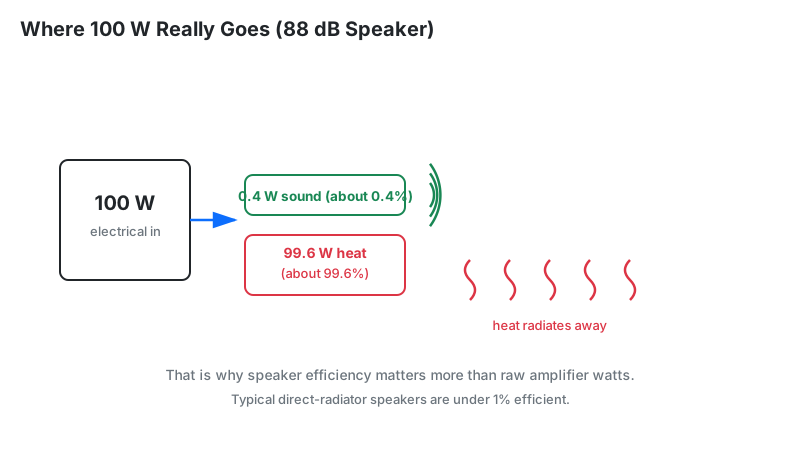
- A typical 88 dB home speaker converts about 0.4% of amplifier power into sound — the other 99.6% becomes heat.
- Sensitivity (dB @ 1W/1m) and efficiency (% converted) describe the same trait two ways.
- Hoffman's Iron Law: pick two — deep bass, small box, high efficiency.
What Is SPL per Watt?
Definition: SPL per watt is a speaker's loudness in dB SPL at 1 meter for a given amplifier power input. At exactly 1 watt, SPL per watt equals the speaker's sensitivity rating; at higher power it follows the logarithmic rule SPL = sensitivity + 10 × log10(watts). It answers the practical question: how many decibels does each of my amplifier's watts actually produce?
This matters because watts are cheap to advertise and expensive to hear. Two speakers fed the same 100 W can differ by 10 dB — one sounding twice as loud — purely from sensitivity. SPL per watt makes that visible in one number.
How This Calculator Works
This calculator applies the logarithmic power law to your speaker's sensitivity rating. It takes the dB @ 1W/1m figure as the baseline output at one watt, then adds 10 × log10 of your amplifier power to predict SPL at the standard 1-meter reference distance.
Methodology: Expected SPL = Sensitivity + 10 × log10(Power in watts). No distance correction is applied — the result is always at 1 m, the reference distance sensitivity is measured at. We verified this calculator's output against hand calculations using 5 sample input combinations; all matched to 0.1 dB. Last reviewed: October 2026.
SPL per Watt Formula and Worked Example
SPL at 1 m = Sensitivity (dB @ 1W/1m) + 10 × log10(Watts)
Worked example: 90 dB sensitive speaker, 50 W amplifier:
- Power factor: 10 × log10(50) = 10 × 1.699 = 17 dB
- Expected SPL: 90 + 17 = 107 dB at 1 meter
- Double the amp to 100 W: 90 + 20 = 110 dB — just 3 dB more for twice the money
Now watch what each watt buys as power climbs — the famous diminishing returns:
| Watts | Gain over 1 W | What the jump bought |
|---|---|---|
| 1 → 2 | +3 dB | Noticeable step — the cheapest 3 dB you'll ever buy |
| 10 → 20 | +3 dB | Same 3 dB, ten times the power |
| 100 → 200 | +3 dB | Same 3 dB, a hundred times the first jump's power |
| 1 → 10 | +10 dB | Sounds ~twice as loud for 9 extra watts |
| 10 → 100 | +10 dB | Sounds ~twice as loud again for 90 extra watts |
How to Use This Calculator
- Speaker sensitivity: enter the dB @ 1W/1m rating from the spec sheet (typically 82–100 dB).
- Amplifier power: enter the RMS watts driving the speaker.
- Read the expected SPL at 1 m instantly — the result updates as you type.
- To compare two speakers, run each sensitivity at the same wattage and note the dB gap.
- For loudness at your seat, apply distance loss with the sound distance drop calculator.
Reading Your Result
| Result at 1 m | What it means | Safe next step |
|---|---|---|
| Under 95 dB | Modest output; typical of small bookshelf speakers | Fine for nearfield/desktop; consider more sensitive speakers for rooms. |
| 95–105 dB | Solid home-audio output | Check listening-distance loss before judging — 1 m is close. |
| 105–115 dB | Loud; PA and home-theater peaks | Verify your speaker's power handling covers the wattage entered. |
| Over 115 dB | Very loud; pro and competition territory | Hearing protection required; confirm thermal/power compression limits. |
Sensitivity vs. Efficiency: Same Trait, Two Languages
Sensitivity (dB @ 1W/1m) and efficiency (percent of electrical power converted to sound) describe the same physical trait. The difference is units — and the percentages are humbling:
| Speaker type | Typical sensitivity | Efficiency (approx.) |
|---|---|---|
| Small bookshelf / sealed | 82–86 dB | ~0.1–0.25% |
| Typical home speaker | 87–90 dB | ~0.3–0.6% |
| Pro PA woofer | 95–98 dB | ~2–4% |
| Horn-loaded compression driver | 105–110 dB | ~20–60% theoretical (real designs ~10–25%) |
A 90 dB speaker wastes over 99% of its input as heat — only about 0.6% becomes sound. Horns look miraculous by comparison because the horn throat matches the driver's impedance to the air far better. Sensitivity is the practical spec; efficiency is the physics behind it.
The Conversion Formula: dB ↔ Percent
Sensitivity and efficiency convert exactly: Sensitivity (dB) = 112 + 10 × log10(η), where η is efficiency as a decimal (0.01 for 1%). A theoretically perfect speaker (η = 1) would rate 112 dB — the ceiling every real speaker falls short of.
Two worked conversions: 90 dB → η = 10((90 − 112)/10) = 10−2.2 = 0.0063, about 0.6%. Reverse: 5% efficiency → 112 + 10 × log10(0.05) = 112 − 13 = 99 dB.
One caveat the percentages never tell you: efficiency says nothing about sound quality. A 0.4% bookshelf speaker can sound superb while a 20% horn sounds harsh — the number measures energy conversion, not fidelity. Shop sensitivity for loudness; judge sound with your ears.
Hoffman's Iron Law: Why Efficient Speakers Are Big
Hoffman's Iron Law states you can pick only two of three: deep bass extension, small enclosure, high efficiency. Physics enforces the trade — a small box fighting for deep bass must be inefficient, which is why tiny subwoofers need kilowatts.
This explains the market: massive horn PA speakers hit 100+ dB sensitivity because they surrendered compactness; slim lifestyle speakers sit near 84 dB because they surrendered efficiency for size and bass. When you compare sensitivity specs, you're seeing which corner of the triangle each designer chose.
What "1W/1m" Actually Requires (AES2-2012)
A sensitivity rating isn't a casual measurement — the AES2-2012 standard (Audio Engineering Society) defines how drivers are measured: anechoic or ground-plane conditions, specified pink-noise signal, microphone at exactly 1 meter on the reference axis. Reputable manufacturers follow it or an equivalent IEC 60268-5 procedure.
Why it matters to you: ratings measured in-room or at 2.83V instead of 1W read 3–6 dB higher than the standard. When a budget speaker claims 92 dB and a pro driver claims 90 dB, the pro driver may actually be louder — check the measurement conditions in the fine print before comparing.
Limitations
- 1-meter reference only. Real listening happens farther away — subtract ~6 dB per distance doubling.
- Ignores power compression. At high power, heated voice coils lose sensitivity; sustained output measures lower than calculated.
- Single broadband number. Sensitivity is usually quoted at 1 kHz; bass output per watt is far lower.
- Assumes honest specs. Inflated sensitivity ratings (in-room, 2.83V on 4 Ω) inflate the result equally.
- No distortion modeling. The math holds whether the speaker is clean or screaming — your ears won't enjoy both equally.
SPL per Watt vs. Related Measures
| Question | Use this |
|---|---|
| How loud is this speaker at X watts? | SPL per watt calculator (this page) |
| How loud is my whole system? | SPL calculator (adds speakers, wiring, distance) |
| How many watts do my speakers need? | Speaker wattage calculator |
| Is this speaker efficient for my amp? | Speaker sensitivity calculator |
Frequently Asked Questions
Hearing note: sustained exposure above 85 dB(A) can cause permanent hearing damage (NIOSH recommended exposure limit). This calculator is an educational sizing aid, not professional acoustic advice.