Audiobook Price Calculator
Last updated: October 18, 2026 · Written by the Pitch Detectors Editorial Team
This audiobook price calculator is for listeners buying finished audiobooks. It compares what you pay per hour across formats — Audible credit, cash, CD, subscription — and ranks them cheapest-first. It does not estimate audiobook production costs.
Key Takeaways
- Cost per hour = price ÷ total hours. It is the fairest way to compare an Audible credit, a CD set, and a direct purchase of the same book.
- The calculator sorts every format cheapest-first, marks the winner Best Value, and shows your savings versus the priciest option.
- A $14.95 Audible credit costs $0.75/hour on a 20-hour book but $2.99/hour on a 5-hour book — credits win on long books and lose on short ones.
- The math assumes you finish the book. Quitting halfway doubles your effective cost per hour.
- This tool serves buyers, not producers. Narrator fees and studio budgets are a different calculation.
What Is an Audiobook Price Calculator?
The same title can be bought five ways: an Audible credit, a cash purchase, a CD box set, a subscription stream, or a direct download from the author. Sticker prices hide the real comparison because the editions differ in length.
Cost per hour removes that distortion.
How This Audiobook Price Calculator Works
For every format you enter, the calculator runs the same three-step method. We checked each step against this page's own calculation code.
- Convert the duration to hours. Hours and minutes become one number: total hours = hours + (minutes ÷ 60). An 8h 30m book becomes 8.5 hours.
- Compute the unit costs. Cost per hour = price ÷ total hours. Cost per minute = cost per hour ÷ 60, shown to three decimals.
- Rank and compare. Formats are sorted from lowest to highest cost per hour. The cheapest gets the Best Value badge. Compare two or more formats and the tool computes potential savings: (most expensive $/hr − cheapest $/hr) × the cheapest format's duration.
Formats with a missing price or a zero duration are skipped with a prompt to fill in valid values — they never silently distort the ranking.
Formula and Worked Example
The two core formulas:
Cost per hour = price ÷ total hours
Savings = (highest $/hr − lowest $/hr) × cheapest format's duration
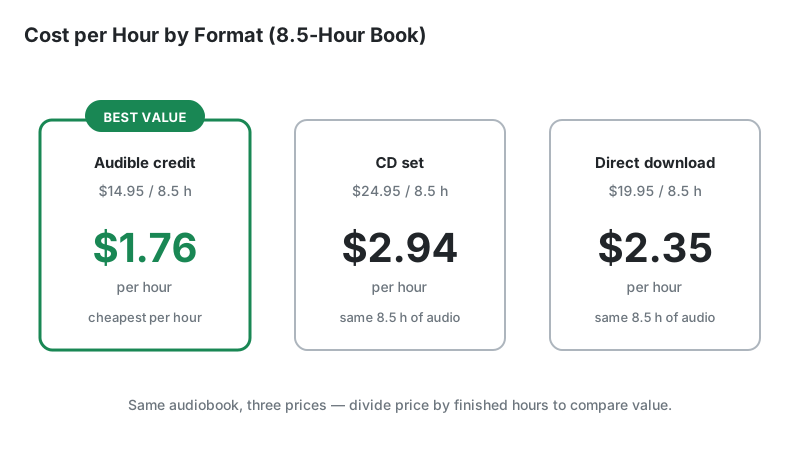
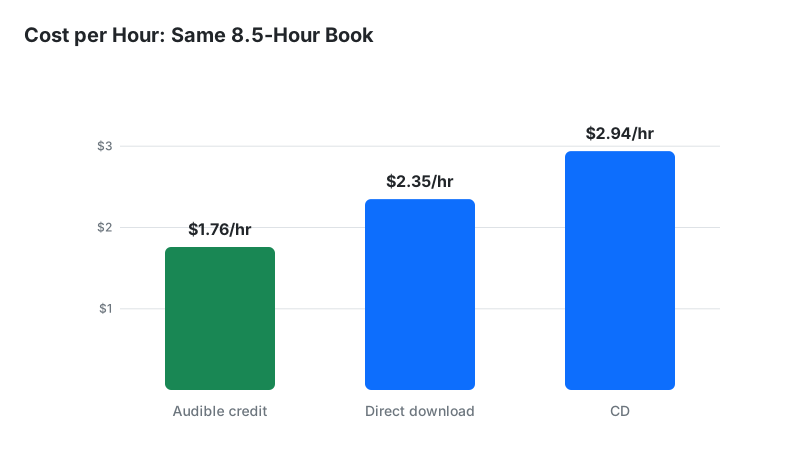
Worked example: the same 8-hour-30-minute audiobook bought two ways — an Audible credit at $14.95 and a CD set at $24.95.
- Duration: 8 + (30 ÷ 60) = 8.5 hours
- Audible credit: $14.95 ÷ 8.5 = $1.76/hr ($0.029/min)
- CD set: $24.95 ÷ 8.5 = $2.94/hr ($0.049/min)
- Ranking: the credit wins Best Value; savings = ($2.935 − $1.759) × 8.5 = $10.00 (the widget uses unrounded values, so it lands exactly on ten dollars)
Enter these numbers above and the tool shows exactly this: the credit marked Best Value and "Save $10.00 ($1.18/hr) by choosing Audible Credit."
How to Use This Audiobook Price Calculator
- Name the first format (for example, "Audible Credit", "CD", or "Direct Download").
- Enter its price in dollars and its duration in hours and minutes. Use the exact edition's length — editions of the same title can differ by an hour or more.
- Click "Add Another Format" and repeat for each purchase option you want to compare. There is no limit.
- Click "Calculate & Compare." The results list every format cheapest-first, with total price, duration, cost per hour, and cost per minute for each.
Tip: compare the same book across formats for a buying decision, or compare different books at the same price to see which gives you more listening per dollar.
Reading Your Result
Each format gets a comparison card with four numbers. Here is what each one tells you:
| Number on the card | What it means | How to use it |
|---|---|---|
| Total price | What you pay out of pocket | Check it fits your budget right now |
| Duration | Listening hours you get | Longer is not automatically better value |
| Cost per hour | The ranking metric — price normalized by length | Pick the lowest for the best value |
| Cost per minute | The same figure at finer resolution | Useful when two options tie per hour |
| Potential savings | Dollars saved by picking the cheapest over the priciest, scaled to the cheapest format's length | Decide whether the gap is worth switching formats |
When an Audible Credit Wins: the Break-Even Table
A $14.95 Audible credit has no fixed per-hour value — the book's length sets it. Premium Plus grants one credit per month, redeemable for any premium title.
Divide $14.95 by the book's hours to see what the credit really costs you:
| Book length | Credit's effective $/hr | Verdict |
|---|---|---|
| 5 hours | $2.99 | Often loses to a sale price — compare cash first |
| 8 hours | $1.87 | Beats most cash prices |
| 10 hours | $1.50 | Strong value |
| 15 hours | $1.00 | Excellent value |
| 20 hours | $0.75 | Best value in the catalog |
Rule of thumb: below about 7 hours, check the cash price before spending a credit. Above 10 hours, the credit almost always wins.
And Premium Plus members get 30% off additional cash purchases, which can beat the credit math on short sale titles.
Why Cost Per Hour Beats Sticker Price
Sticker price answers the wrong question. A $24.95 CD looks cheaper than a $29.95 download — until you notice the CD holds 8.5 hours and the download holds 14.
The download costs $2.14/hour; the CD costs $2.94/hour. The "expensive" option is the better deal.
The same math tests subscription claims. A ~$7.95/month unlimited plan sounds unbeatable — but finish one 8-hour book that month and your effective cost is about $0.99/hour. An unused month costs infinitely more per hour.
The per-hour math forces you to count what you actually consume, not what you could consume.
Subscription Math: What "Unlimited" Really Costs
A subscription's per-hour cost depends entirely on how much you finish. Take Audible Plus at about $7.95/month for unlimited streaming from the Plus Catalog (no credits, no ownership):
| Books finished per month | Hours listened (10h books) | Effective $/hr |
|---|---|---|
| 1 | 10 | $0.80 |
| 2 | 20 | $0.40 |
| 4 | 40 | $0.20 |
Heavy, consistent listeners get the lowest per-hour rate of any format. Occasional listeners get the highest — a month you finish nothing still costs $7.95.
Spotify's model differs: Premium includes 15 audiobook hours per month (unused hours do not roll over), with extra 10-hour top-ups sold separately.
Inside the 15-hour cap, each additional book costs $0 extra, which makes Spotify unbeatable for steady one-to-two-book-a-month listeners who stay under the cap.
The Best-Value Trap: It Only Counts If You Finish
Every per-hour figure on this page assumes you listen to the whole book. Abandoning a book doubles its effective cost per hour — a 10-hour book you quit halfway through cost twice the displayed rate.
A $0.75/hour credit on a 20-hour epic you abandon at hour 10 is really $1.50/hour for nothing finished.
This flips the ranking for chronic book-abandoners. Before chasing the lowest number, ask the honest question: which format matches how you really listen? The best value is the cheapest option among the formats you will actually finish.
What the Formats Mean: Credits, Subscriptions, and Hour Buckets
The names you type into the format boxes usually map to one of these real-world buying models:
| Format | How it works (USA) | When it wins on $/hr |
|---|---|---|
| Audible credit (Premium Plus) | $14.95/month for 1 credit, good for any premium title; books are yours to keep; members get 30% off extra purchases | Long books: a 20-hour epic at $14.95 costs $0.75/hr |
| Audible Plus subscription | About $7.95/month for unlimited streaming from the Plus Catalog (no credits, no ownership) | Heavy listeners who finish 3 or more included titles monthly |
| Spotify Premium audiobook hours | 15 listening hours/month included with Premium; extra 10-hour top-ups available; unused hours do not roll over | Steady 1–2 book/month listeners inside the 15-hour cap |
| Cash / direct purchase | One-time payment, yours forever | Short books on sale, or titles you will re-listen to for years |
| CD / physical | One-time payment plus shelf space | Rarely — mostly for collectors or cars without Bluetooth |
Pricing details: Audible's $14.95/month Premium Plus terms and the 30% member discount are published plan terms. Spotify's 15-hour monthly audiobook allowance for Premium subscribers is documented in Spotify's official announcement. Prices change, so verify at checkout.
Producing an Audiobook Instead of Buying One
This calculator compares what listeners pay for finished audiobooks across purchase formats. It does not estimate production budgets — "audiobook price" covers two different things, and production math belongs to a different calculation.
Producing an audiobook is a separate calculation with different cost drivers: narrator fees (usually quoted per finished hour of audio), editing, mastering, proofing, and distribution.
One caution if you arrived here from a production search: the often-quoted "$300–$400 per finished hour" narrator range traces back to ACX's June 2013 budgeting article, not a 2026 market survey — treat dated figures as history, not quotes.
Use the Audiobook Length Calculator for a book's runtime first — the starting point of any production estimate.
Limitations
- Ownership is not priced in. A credit purchase you keep forever and a subscription stream you lose on cancellation can show the same $/hr. The calculator measures price, not long-term value.
- Assumes full listening. As the best-value trap section explains, unfinished books cost more per hour than displayed.
- Savings scale to the cheapest format's duration. The "Potential Savings" figure multiplies the per-hour gap by the cheapest option's length — a fair comparison when all formats hold the same book, less meaningful across different titles.
- No tax, shipping, or membership proration. Enter the all-in price you actually pay for the most accurate ranking.
- Prices move. Sales, expiring credits, and plan changes can reorder the ranking overnight; re-run the numbers at purchase time.
Cost Per Hour vs Other Ways to Compare
| Method | What it measures | Best for |
|---|---|---|
| Cost per hour (this tool) | Price normalized by listening time | Comparing formats of the same book |
| Sticker price | Out-of-pocket cost | Staying inside a fixed budget |
| Cost per book | Average spend per title | Subscription value over a year |
| Length estimation first | Duration from word/page count | Pricing an unreleased manuscript |
Frequently Asked Questions
Disclaimer: this tool is for informational purposes only and is not financial advice. Prices, plan terms, and catalog availability change frequently — always verify the current price before purchasing.