Online Guitar Tuner
Last updated: October 23, 2026 · Written by the Pitch Detectors Editorial Team
Free chromatic tuner with real-time mic pitch detection for acoustic guitar, electric guitar, bass, and ukulele. Your audio is analyzed on your device — nothing is recorded or uploaded.
An online guitar tuner listens through your device's microphone and shows, in real time, whether each string is sharp or flat. Pluck a string, read the note name, frequency, and cents value, then turn the tuning peg until the meter settles near zero. Detection is fully chromatic — it names the nearest note to whatever you play — and 7 presets (standard, Drop D, half-step-down, Open D, DADGAD, bass, and ukulele) load each tuning’s notes as clickable reference tones. Everything runs in your browser: no download, no account, and no audio ever leaves your device.
Key Takeaways
- This tuner measures your string's frequency and reports the gap to the target note in cents — hundredths of a semitone.
- Standard tuning is E2–A2–D3–G3–B3–E4 at A4 = 440 Hz; bass, ukulele, and four alternate tunings (Drop D, half-step-down, Open D, DADGAD) are built in.
- Tune to the sustain, not the attack: strings ring sharp right after the pluck and settle as the note decays.
- Always tune up to pitch from below — tuning gears hold tension more reliably that way.
- Microphone tuning needs a quiet room, HTTPS, and mic permission — and your audio stays on your device, never recorded or uploaded. On a noisy stage, a clip-on tuner works better.
- Go through all six strings twice: tightening one string pulls the neck and nudges the others flat — the second pass is the one that locks chords in.
What Is an Online Guitar Tuner?
An online guitar tuner is a browser-based tool that uses your device's microphone to measure each plucked string's pitch in real time. It finds the string's fundamental frequency in hertz, compares it to the nearest target note, and displays the difference in cents — telling you exactly how far, and in which direction, to turn the tuning peg.
Most online tuners are chromatic: they identify any note, not just the six open strings. This tuner pairs chromatic detection with presets for standard, bass, ukulele, Drop D, half-step-down, Open D, and DADGAD tunings, so the target notes match the tuning you are aiming for.
How This Tuner Works
This tuner grabs short slices of microphone audio and runs an autocorrelation algorithm — a standard pitch-detection technique — to find the string's fundamental frequency: the lowest, strongest vibration in the plucked note.
Each slice holds 4,096 audio samples (about a tenth of a second at 44,100 Hz). The algorithm compares the slice against delayed copies of itself; the delay that lines up best reveals the wave's period, and parabolic interpolation between neighboring delays sharpens the estimate beyond the sample grid. A loudness gate ignores silence and background hiss so the meter only reacts to real notes.
The measured frequency is converted to the nearest note name, and the gap is shown in cents: 1,200 × log₂(measured ÷ target). The A4 reference defaults to 440 Hz and can be set from 430 to 450 Hz to match pianos, orchestras, or recordings tuned to 432 Hz. All analysis runs locally in the page: the microphone feed never leaves your device and is never recorded or stored. The presets change the reference-tone grid under the meter — detection itself always reports the nearest note, whatever preset is selected. The detection approach follows the same autocorrelation method published in Chris Wilson's open-source PitchDetect reference, which underlies many browser tuners.
Tuning Math: The Cents Formula and a Worked Example
Cents turn tiny pitch gaps into readable numbers: 100 cents equals one semitone (one fret), and each semitone multiplies frequency by about 1.05946. The formula is cents = 1,200 × log₂(f_measured ÷ f_target).
Worked example: your low E string should be 82.41 Hz. The tuner reads 81.95 Hz: 1,200 × log₂(81.95 ÷ 82.41) ≈ −9.7 cents. The string is roughly 10 cents flat — tighten the 6th-string peg in small turns and pluck again until the readout holds near zero.
The formula runs in reverse too: the frequency 8 cents above A2 (110.00 Hz) is 110 × 2^(8÷1200) ≈ 110.51 Hz. For repeated conversions, the Cents Calculator does this arithmetic for any interval.
How to Use This Guitar Tuner
- Click Start Tuner and allow microphone access — the browser asks once, and the page must load over HTTPS.
- Pick a tuning preset: Standard, Drop D, Half Step Down, Open D, DADGAD, Bass, or Ukulele. The target notes and reference tones update automatically.
- Mute the strings you are not tuning with your palm, then pluck the target string with a medium pick — not a hard attack, which reads sharp.
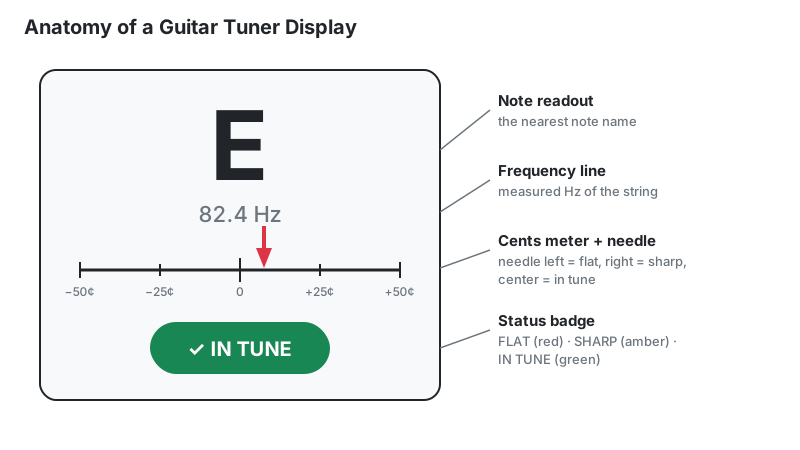
- Watch the note name, frequency, and cents meter. Turn the peg slowly until the readout holds near 0 cents and the status badge turns green.
- Tune up to every note: if a string is sharp, loosen it below the target first, then tune upward into pitch.
- Make a second pass. Tightening later strings pulls the neck and nudges the earlier ones flat — the second circuit is the one that makes chords sound right.
- Optional: tap a reference note to hear the target pitch, or set the A4 reference (430–450 Hz) to match an orchestra or a 432 Hz recording.
Reading Your Result
The big readout names the detected note; the meter and cents value show how far you are from it. The bar spans ±50 cents, with the needle at center meaning zero.
| Cents reading | Display | Meaning | Next step |
|---|---|---|---|
| 0 to ±5 | green "✓ In Tune!" — and the "Perfect Tune!" panel appears | close enough for ensemble playing | move to the next string |
| 6–15 flat | red "↓ Flat - Tighten string" | slightly below pitch | small tightening turns |
| 6–15 sharp | amber "↑ Sharp - Loosen string" | slightly above pitch | loosen below target, then tune up |
| 16–49 either way | same badges | clearly off | adjust slowly and re-pluck gently |
| beyond ±50 | — | you are closer to a neighboring note | check the preset and string |
Trust the sustain, not the attack: give the needle a second to settle after each pluck before calling the string done.
Right note, wrong octave? The detector has latched onto the string’s second harmonic instead of its fundamental. Mute the other strings, pluck once with medium force near the soundhole — or over the 12th fret, which emphasizes the fundamental — and let the note ring.
Tune to the Sustain, Not the Attack
A freshly plucked string rings sharp — the needle overshoots, sometimes by 20 cents or more on a hard pluck — then drifts flatter as the note decays. This is the single most misunderstood thing about electronic tuners.
The physics is straightforward: a wide vibration stretches the string, raising its average tension and therefore its pitch. Pitch holds steady only when the vibration's width is tiny compared with the string's length. Pluck harder and the effect grows; thin, low-tension strings shift more than thick ones.
The practical rule: pluck with medium force and trust the meter one to two seconds in, on the sustain — that is the pitch your audience actually hears. Players on the Acoustic Guitar Forum report the same behavior across mic and clip-on tuners, and the MIDI Guitar FAQ documents it as a known hurdle for pitch-to-MIDI tracking.
Sweetened Tuning: James Taylor's Cent Offsets
James Taylor deliberately tunes every string slightly flat — specific offsets that compensate for the ways real playing pulls pitch sharp.
| 6th (low E) | 5th (A) | 4th (D) | 3rd (G) | 2nd (B) | 1st (high E) |
|---|---|---|---|---|---|
| −12 | −10 | −8 | −4 | −6 | −3 |
Two reasons drive the offsets. First, capo pressure squeezes strings sharp — most on the bass strings. Second, bass strings ring sharp at the attack, as described above. Peterson strobe tuners ship his numbers as the "ACU" sweetened preset.
One caution from the same interview (MusicRadar): without a capo the result can sound noticeably flat. Treat sweetened tuning as a capo player's tool: with this tuner, tune each string until the cents readout holds at its offset (−12, −10, −8, −4, −6, −3) instead of at zero.
Why 5th-Fret Harmonic Tuning Drifts
Tuning by matching 5th- and 7th-fret harmonics builds just-intonation fifths — pure 3:2 ratios that are each 2 cents sharp of the equal-tempered fifths your frets use. Across six strings that drift compounds to roughly 10 cents.
Harmonics divide the string into whole-number ratios, which is perfect within one key; modern frets split the octave into twelve equal steps so every key works. A harmonic-tuned guitar is fine for a quick check, but confirm with a tuner afterward — the analysis is laid out in a widely cited diyAudio thread on the method.
Humidity, Temperature, and New Strings
When humidity rises, your guitar goes sharp; when it falls, the guitar goes flat. Moist air swells the wood, stretching the strings tighter; dry air lets the wood shrink and tension drops. Players on the Acoustic Guitar Forum report exactly this pattern season after season.
New strings are the other classic drifter: they stretch under full tension for the first day or two. Break them in by tuning to pitch, gently lifting each string about an inch at the 12th fret, and retuning — repeat three or four times until the pitch holds. A light-gauge acoustic set pulls about 160 pounds in total (per player-compiled D'Addario tension charts), so the neck and strings need a little time to settle into agreement.
One more stability fix: if a string jumps in pitch with an audible "ping" while you tune, it is binding in the nut slot. A pencil tip of graphite in the slot usually cures it.
Open-String Frequencies and Tuning Presets
Every preset in this tuner maps to exact frequencies at A4 = 440 Hz:
| Instrument | String | Note | Frequency |
|---|---|---|---|
| Guitar | 6th (thickest) | E2 | 82.41 Hz |
| 5th | A2 | 110.00 Hz | |
| 4th | D3 | 146.83 Hz | |
| 3rd | G3 | 196.00 Hz | |
| 2nd | B3 | 246.94 Hz | |
| 1st (thinnest) | E4 | 329.63 Hz | |
| Bass | 4th (low) | E1 | 41.20 Hz |
| 3rd | A1 | 55.00 Hz | |
| 2nd | D2 | 73.42 Hz | |
| 1st (high) | G2 | 98.00 Hz | |
| Ukulele | 4th | G4 | 392.00 Hz |
| 3rd | C4 | 261.63 Hz | |
| 2nd | E4 | 329.63 Hz | |
| 1st | A4 | 440.00 Hz |
Drop D lowers only the 6th string to D2 (73.42 Hz) for one-finger power chords. Half Step Down drops everything a semitone (E♭ tuning) for a slacker feel and easier bends. DADGAD (D2–A2–D3–G3–A3–D4) gives an open, droning Celtic color; Open D (D–A–D–F♯–A–D) rings a full D major chord for slide work. Going lower than these presets usually calls for heavier string gauges to keep tension playable. For the exact hertz of any note, the Note to Frequency tool computes it from any A4 reference.

Tuning Acoustic, Electric, Bass, and 12-String Guitars
One chromatic engine covers the whole guitar family — acoustic, electric, bass, and 12-string. The detector identifies any note you play rather than only the six standard strings, and a few adjustments per instrument give you faster, more stable readings.
Acoustic guitar
As an acoustic guitar tuner, this tool listens through your microphone, so placement matters. Set your phone or laptop about 30 cm (12 inches) from the soundhole, slightly off-axis — dead-center picks up too much boomy low end and confuses the reading on the low E and A strings. Pluck with your fingertip rather than a pick for a cleaner fundamental, and let each note ring for a full second so the tuner locks onto the sustain.
Electric guitar
For an electric guitar tuner session, an unplugged solid-body is quiet but perfectly usable: hold the microphone near the upper bout, away from your picking hand, and pluck firmly. If the room is noisy, roll your tone knob down slightly — it trims the harsh attack harmonics and leaves a purer fundamental for the detector. Humbuckers and single-coils both work; the tuner only needs the acoustic vibration reaching the mic.
Bass guitar
Used as a bass guitar tuner, the same chromatic engine tracks down to the low B of a 5-string (30.87 Hz). Low notes need a longer analysis window, so let each string ring for two full seconds and keep background noise down — air conditioners and computer fans live in the same frequency neighborhood as your E string. Tune the low strings first; their vibration can sympathetically excite the higher strings and blur their readings.
12-string and classical guitars
On a 12-string guitar, tune the six primary (lower-octave) strings first with the octave pairs muted — lightly touch the octave strings with your fretting hand while you pluck. Then tune each octave string against its partner. For a classical guitar with nylon strings, expect more drift: nylon stretches for days, so tune up, play for five minutes, and tune again. New nylon trebles can take a full week to settle.
Limitations
- Noise wins: in a loud room the meter reacts to voices and drums, not your guitar — use a clip-on tuner on stage.
- Microphone access needs HTTPS and your permission; some browsers block the mic if another app is already using it.
- Very low bass notes and whisper-quiet unplugged electrics give weaker, jumpier readings — get close to the mic.
- Chromatic detection names the nearest note, not the intended string: with the wrong preset, it will happily confirm the wrong note.
- A tuner cannot fix intonation: if the open string reads 0 but the 12th-fret note is sharp, the bridge saddle needs moving, not the peg.
- Match your reference: tuning to 440 Hz while the band plays at 442 Hz still sounds out of tune — check the Frequency to Note tool if you are matching a recording.
Online Tuner vs. Other Tuners
| Tool | Best for | Trade-off |
|---|---|---|
| This online tuner | quick, free tuning anywhere with a microphone | needs a quiet room and HTTPS mic access |
| Clip-on tuner | noisy stages — reads vibration, not sound | costs roughly $10–30; needs a battery |
| Pedal tuner | live rigs — mutes the signal while you tune | pedalboard only, not portable |
| Tuning fork / pitch pipe | one reference note anywhere, no batteries | only one note; the rest is tuned by ear |
| Transpose Calculator + this tuner | retuning for a capo or a singer's key | two steps instead of one |