Harmonic Series Calculator
Builds the partial series for any fundamental with a generalized formula — scaling, exponent and addition constants. Every row shows frequency, MIDI number, piano key, note name and cents adjustment, ready to copy as tab-delimited data or download as TSV.
Harmonic / Subharmonic Table
| # | Frequency (Hz) | MIDI # | Keyboard Key | Pitch | Adjustment (cents) | Play |
|---|---|---|---|---|---|---|
| No harmonics generated yet — click Generate. | ||||||
Harmonic Series Calculator: Overtones & Partials
Last updated: October 23, 2026 · Written by the Pitch Detectors Editorial Team
A harmonic series calculator takes any fundamental pitch and lists its harmonics — the integer-multiple overtones (2f, 3f, 4f…) that shape every instrument's timbre — with exact frequencies, MIDI and piano-key numbers, note names, and each partial's distance from 12-tone equal temperament in cents. Generate up to 256 partials, play each one as a sine tone, export the table — then push past the ideal math with the scaling, exponent, and quantization controls.
Key Takeaways
- The harmonic series is f, 2f, 3f, 4f… — every member is an integer multiple of the fundamental pitch.
- Watch the terminology: the fundamental is the 1st harmonic, but the 1st overtone is the 2nd harmonic (2f) — the most common beginner mistake.
- Natural harmonics don't match the piano: the 7th harmonic sits −31.17 cents flat of the equal-tempered minor seventh; the 11th is −48.68 cents flat of the tritone.
- Real strings stretch sharp of theory (inharmonicity), which is why piano tuners stretch-tune octaves — and why this calculator has an exponent control.
- The missing fundamental lets your brain hear bass notes that aren't physically present — it's why voices sound normal on a telephone that cuts everything below 300 Hz.
What Is the Harmonic Series?
The physics is straightforward. A guitar string fixed at both ends vibrates only in patterns that fit between its fixed points — the whole string, halves, thirds, quarters. Each pattern (a normal mode) vibrates at an integer multiple of the fundamental, with wavelength λn = 2L ÷ n for a string of length L.
Terminology trips up beginners, so lock this in:
| Term | Meaning | Example (f = 100 Hz) |
|---|---|---|
| Fundamental (1st harmonic) | The lowest member; the perceived pitch | 100 Hz |
| Harmonic | The n-th member of the series | 3rd harmonic = 300 Hz |
| Overtone | Any member above the fundamental | 1st overtone = 200 Hz (the 2nd harmonic) |
| Partial | Any component of a complex tone | Piano partials are slightly inharmonic — not exact integers |
"Partial" is the umbrella term: harmonic partials hit exact integer ratios, while inharmonic partials (bells, stiff piano strings) miss them — and "overtones" never includes the fundamental itself.
How This Calculator Works
Enter a fundamental note or frequency and the tool builds the series with one generalized formula:
With the defaults (scaling s = 1.0, exponent e = 1.0, addition α = 0) this collapses to the pure series fn = n × f0. Each row reports the frequency (2 decimals), the rounded MIDI note number, the keyboard key — the piano key count from A0, so MIDI 21 = key 1 — the nearest note name at A4 = 440 Hz (sharp spellings: C♯5, never D♭5), and the adjustment in cents: the partial's distance from that nearest equal-tempered note, rounded to whole cents (positive = sharp, negative = flat). The play button synthesizes each partial as a one-second pure sine tone.
Three extra controls go further. Scaling (s) re-spaces the partials: s = 0.5 inserts half-harmonics at 1.5f, 2.5f…. Exponent (e) above 1.0 sharpens high partials progressively, modeling string stiffness. Quantize snaps displayed frequencies to grids of 1, ½, ¼, or ⅛ semitone, and the Subharmonics checkbox switches the α term from added to subtracted. Every worked example here was recomputed from the generator's own formula and cross-checked by hand. Last reviewed: October 2026.
The Formulas and Worked Examples
Two formulas cover the pure series — multiply going up, divide going down:
Harmonics (Otonality)
Exact integer multiples of the fundamental.
Subharmonics (Utonality)
Undertones descending below the fundamental.
Worked example — harmonics of A2 (110 Hz):
- 1st harmonic (fundamental): 1 × 110 = 110.00 Hz (A2)
- 2nd: 2 × 110 = 220.00 Hz (A3, one octave up)
- 3rd: 3 × 110 = 330.00 Hz — E4 is 329.63 Hz, so this partial sits +1.96 cents sharp
- 4th: 4 × 110 = 440.00 Hz (A4, concert pitch)
- 5th: 5 × 110 = 550.00 Hz — C♯5 is 554.37 Hz, so this partial sits −13.69 cents flat
Worked example — subharmonics of C2 (65.41 Hz): the utonal series divides instead of multiplying: 65.41 ÷ 2 = 32.70 Hz (C1), ÷ 3 = 21.80 Hz, ÷ 4 = 16.35 Hz (C0). These undertones mirror the harmonics below the fundamental. If you don't know your fundamental in Hz, look it up with the note-to-frequency converter first.
How to Use This Calculator
- Set the fundamental: pick a note and octave, or type an exact frequency in Hz — the note picker auto-fills the Hz box, which stays editable.
- Choose the partial count: 16 is the default; raise it toward 256 to study the extreme upper series.
- Scaling factor (s): leave at 1.0 for the natural series; try 0.5 for half-integer partials.
- Exponent (e): leave at 1.0 for ideal harmonics; nudge above 1.0 to model stiff-string inharmonicity.
- Frequency addition (α): leave at 0, or offset every partial by a fixed Hz amount.
- Quantize microtones: snap the displayed frequencies to the nearest semitone, quarter-tone, eighth-tone, or sixteenth-tone grid point.
- Subharmonics checkbox: the panel's utonal mode — the inverted series defined in the subharmonics section below.
- Generate: the table fills with frequency, MIDI number, keyboard key, note name, and cents adjustment per partial.
- Listen and export: play any row as a sine tone, copy the tab-delimited output into Excel/Sheets, or download the TSV.
Reading Your Result
Different partial ranges do different jobs in a sound. Use this table to read the output:
| Partials | What they add | Example on A2 (110 Hz) |
|---|---|---|
| 1 (fundamental) | The perceived pitch and the body of the note | 110 Hz |
| 2–3 | Warmth and fullness | 220, 330 Hz |
| 4–8 | Brightness and presence | 440–880 Hz |
| 9–16 | Edge, "ping," and air | 990–1,760 Hz |
The adjustment (cents) column shows how each partial relates to the piano keyboard: +2 cents on the 3rd harmonic is negligible, but −13.7 cents on the 5th and −31.2 cents on the 7th explain why natural harmonics sound "off" against equal temperament. Deviations beyond ±15 cents matter in intonation work — measure them with the cents calculator.
The First 16 Partials: Ratios, Intervals and Cents
Every fundamental produces the same interval pattern — the cents deviations below are fixed by the ratios, so this table holds for any starting note. It is the reference the generator's first 16 rows follow at default settings:
| Partial | Ratio to f0 | Interval above fundamental | Cents vs nearest 12-TET note |
|---|---|---|---|
| 1 | 1:1 | Unison | 0 |
| 2 | 2:1 | Octave | 0 |
| 3 | 3:1 | Octave + perfect 5th | +2 |
| 4 | 4:1 | Two octaves | 0 |
| 5 | 5:1 | Two octaves + major 3rd | −14 |
| 6 | 6:1 | Two octaves + perfect 5th | +2 |
| 7 | 7:1 | Two octaves + minor 7th | −31 |
| 8 | 8:1 | Three octaves | 0 |
| 9 | 9:1 | Three octaves + major 2nd | +4 |
| 10 | 10:1 | Three octaves + major 3rd | −14 |
| 11 | 11:1 | Three octaves + tritone | −49 |
| 12 | 12:1 | Three octaves + perfect 5th | +2 |
| 13 | 13:1 | Three octaves + minor 6th | +41 |
| 14 | 14:1 | Three octaves + minor 7th | −31 |
| 15 | 15:1 | Three octaves + major 7th | −12 |
| 16 | 16:1 | Four octaves | 0 |
Three partials break the piano's grid hardest: the 7th (−31), the 11th (−49), and the 13th (+41). At 840.5 cents the 13th falls between the minor and major sixth, closer to the minor — which is why the table names that interval.
Why a Clarinet Sounds Nothing Like a Flute
Here is the harmonic series deciding what an instrument is. A clarinet is a cylindrical pipe closed at one end — the reed seals it — and closed pipes support only odd harmonics (1, 3, 5…), because air pressure must peak at the reed end. A flute is open at both ends, and saxophones and oboes are conical, so they support all harmonics.
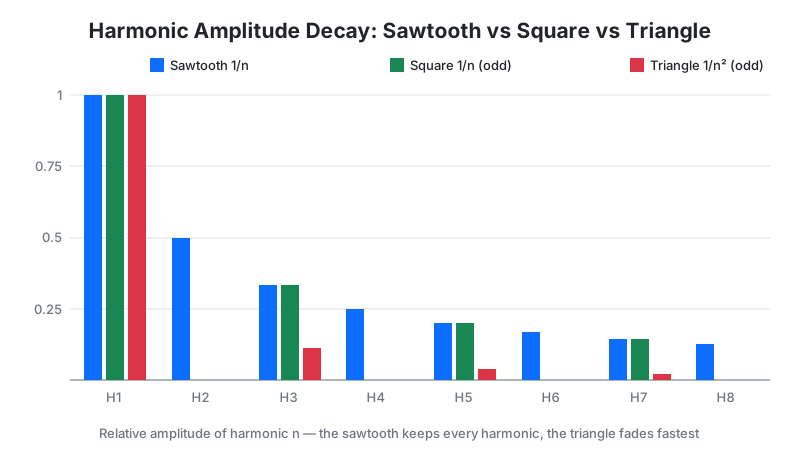
Two consequences follow. First, the clarinet's register key doesn't jump an octave like a flute's — it jumps a twelfth, straight to the 3rd harmonic, skipping the physically missing 2nd. Second, the clarinet's low register sounds hollow and woody for the same reason a square wave does: both are built from odd harmonics falling off as 1/n, a result Joseph Fourier proved for periodic waveforms in 1822. (Woodwind acoustics: Boston University physics lecture notes.)
Subharmonics and Partch's Utonality
The harmonic series has a mirror image. Divide instead of multiply — f0 ÷ 1, f0 ÷ 2, f0 ÷ 3… — and the undertones descend below the fundamental in the same ratios the harmonics climb above it. Theorists call the upward series otonality and the inverted one utonality — terms Harry Partch used for the six-note chords of his tuning system.
Partch built his mature music on an 11-limit tonality diamond — ratios from the primes 1 through 11 — expanded into a 43-tone just-intonation scale described in Genesis of a Music, and built his own instruments to play it. The idea lives on in studios: subharmonic synthesizers generate bass an octave below the input, and EDM producers build sub-bass from the lowest subharmonics of their kicks. Generate the harmonic series here, then move the set to a new root with the transpose calculator.
Modeling Real Strings With the Exponent Knob
No real string vibrates at exact integer multiples. Steel resists bending, so each partial rings slightly sharp of theory — a phenomenon called inharmonicity, quantified by Harvey Fletcher's 1964 string research: fn = n × f0 × √(1 + Bn²), where B is the inharmonicity coefficient (roughly 0.0001–0.001 for piano strings; short upright strings run higher than long grand strings).
This calculator's exponent knob models that stiffness. Set e = 1.009 and the 16th partial lands about +43 cents sharp — matching Fletcher's formula with B ≈ 0.0002 at that partial (both values recomputed for this article). Piano tuners compensate with stretch tuning: octaves tuned slightly wide, so fundamentals line up with the stretched partials of lower strings and beats disappear.
One honest caveat: a single exponent is a rough stand-in, not a calibrated B coefficient — it can't track Fletcher's curve at every partial. Use the knob to feel how stiffness reshapes a spectrum, not to tune a piano.
Where Musicians Meet These Numbers Every Day
Pipe organ stops are harmonic-series labels. An 8′ stop sounds the fundamental; 4′ the 2nd harmonic; the 2⅔′ Nazard the 3rd (a twelfth above); the 1⅗′ Tierce the 5th. Compound stops like the Sesquialtera (2⅔′ + 1⅗′) switch on selected harmonics of the 8′ series. (American Guild of Organists; organstops.org.)
Opera singers engineer their harmonics. The "singer's formant" — a cluster of vocal-tract resonances (formants 3–5) near 3 kHz, first analyzed by Johan Sundberg in 1974 — amplifies whichever harmonics fall in that band, letting an unamplified voice cut through an orchestra.
The missing fundamental is everywhere. Traditional telephones pass only 300–3,400 Hz, yet a male voice with a ~150 Hz fundamental sounds normal on a call — your brain rebuilds the pitch from the surviving harmonics. Alphorn players exploit the series directly: their melodies ride the natural 11th harmonic, the "alphorn Fa," about 49 cents flat of the piano's tritone.

Limitations
- Ideal math, not measured sound. The tool assumes a perfectly flexible string or air column; real instruments add stiffness, end corrections, and bell flare that move partials.
- The exponent knob is illustrative. It sharpens high partials like real inharmonicity, but one exponent can't reproduce any instrument's actual B-coefficient curve — don't use it to tune a piano.
- Cents reference 12-TET at A4 = 440 Hz. Historical temperaments, A415 baroque pitch, and A432 aren't modeled.
- Note names use sharp spellings. The Pitch column writes C♯5, never D♭5 — respell when you need flats.
- Quantize changes the displayed frequency only. The Pitch and Adjustment columns are calculated from the unquantized frequency, so with quantization on, small disagreements between columns are expected behavior, not an error.
- Play buttons make sine tones, not instruments. Real timbre needs each partial's amplitude envelope and phase — this tool shows frequencies only.
- Subharmonics below ~20 Hz are felt more than heard; check your speakers before judging the utonal series by ear.
Harmonic Series vs Other Ways to Describe Pitch
| System | What it measures | Use it when… |
|---|---|---|
| Harmonic series (f, 2f, 3f…) | Exact integer-multiple partials of one fundamental | Timbre, just intonation, instrument acoustics |
| Cents | Logarithmic interval size (100 cents = 1 semitone) | Tuning accuracy, temperament errors — see the cents calculator |
| Frequency ratios (3:2, 5:4) | Pure harmonic relationships | Building just-intonation scales from the series |
| 12-tone equal temperament | 12 equal semitones per octave | Talking to pianists — and measuring how far nature deviates |
| MIDI note numbers | Discrete pitch slots (69 = A440) | Programming synths and DAW piano rolls |
| Spectrum analyzer (FFT) | Measured partials of a real recorded sound | Comparing a real instrument against the ideal series |