DJ Transition Calculator
Plan and execute seamless DJ transitions. Calculate BPM differences, transition timing, key compatibility, and optimize tempo adjustments for flawless mixing.
Track A (Outgoing)
Track B (Incoming)
Transition Analysis & Metrics
+4 BPM
128
30s
✓ Good
+3.23%
+0.55 semitones
64 beats
Transition Recommendations:
DJ Transition Calculator: BPM, Key & Timing
Last updated: October 23, 2026 · Written by the Pitch Detectors Editorial Team
A DJ transition calculator plans the blend between two tracks: it converts the BPM gap into a pitch percentage, scores Camelot key compatibility, and converts your bar count into seconds. Enter both tracks' BPM and key, choose a transition length, and get a concrete mix plan — pitch move, key verdict, timing — ready to execute on phrase boundaries.
Key Takeaways
- Pitch % = (target BPM − current BPM) ÷ current BPM × 100. 124 → 128 BPM is +3.23% — inside the ±6% safe-blend zone.
- This calculator checks the nominal key codes you enter. With key lock (Master Tempo) on, the verdict is exact; with key lock off, ~6% pitch shifts the sounding key a full semitone (5.95% = exactly 1 semitone).
- Bars × 240 ÷ BPM = transition seconds. A 32-bar blend at 128 BPM lasts 60 seconds; the same 32 bars at 174 BPM last 44.
- Safe key moves: same code, ±1 number, or relative major/minor (same number, letter swap).
- Match technique to the gap: ≤3 BPM blends naturally, 4–6 BPM is manageable, 7–10 BPM is significant, 10+ BPM needs a cut, breakdown, or bridge track.
What Is a DJ Transition Calculator?
Every transition is three problems at once: tempo (do the BPMs match?), key (do the keys clash?), and timing (when do I start the blend?). Bedroom DJs guess; working DJs calculate. This tool handles the arithmetic so your ears can handle the art — which tracks to pair, how long to blend, and when to cut instead.
How This Transition Calculator Works
Enter Track A's BPM and key and Track B's BPM and key, choose a transition length in bars, and pick which tempo to match. The calculator returns the pitch percentage Track A needs to reach the target, the pitch shift in semitones, a key compatibility verdict (Perfect, Good, Caution, or Clash), and the transition duration in seconds — plus recommendations that adapt to your BPM gap.
Methodology: pitch % = (target − current) ÷ current × 100; semitones = 12 × log₂(target ÷ current); transition seconds = bars × 240 ÷ target BPM (4/4); Camelot adjacency on the entered codes (same code = Perfect; same number letter-swap or ±1 = Good; ±2 = Caution; further = Clash). The key check scores the nominal codes — it does not adjust for your pitch move (see the Camelot section for what that means with key lock on vs off). The formulas reproduce the calculator's own outputs exactly: 124→128 BPM returns +3.23% and +0.55 semitones, with 16 bars timed at 30 seconds; 100→120 returns +20%; 8A→9A returns Good; 8A→2A returns Clash; equal tempos return 0%.
Transition Formulas and Worked Example
- Pitch % = (Target BPM − Track A BPM) ÷ Track A BPM × 100
- Pitch semitones = 12 × log₂(Target BPM ÷ Track A BPM)
- One bar (4/4) = 240 ÷ BPM seconds
- Transition seconds = bars × 240 ÷ target BPM
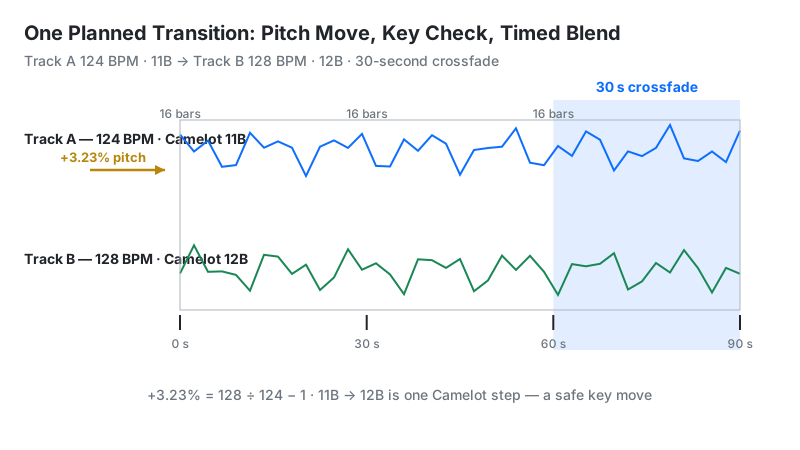
Worked example (the widget's default tempos, bar count and match target, with the keys set to 11B and 12B): blending from a 124 BPM track in 11B to a 128 BPM track in 12B, over 16 bars, matching Track B's tempo:
- Pitch move: (128 − 124) ÷ 124 × 100 = +3.23% on Track A — inside the ±6% safe zone
- Semitone shift: 12 × log₂(128 ÷ 124) = +0.55 semitones — well under 1 semitone, so the key verdict holds even without key lock
- Key check: 11B → 12B is +1 Camelot number = Good
- Timing: 16 × 240 ÷ 128 = 30 seconds
- Plan: pitch Track A up 3.23%, start the blend at a 16-bar phrase boundary, ride it for 30 seconds
Middle-ground variant: choose "Middle ground" with 124 vs 132 BPM and the target becomes 128. The calculator displays Track A's move to that shared target: +3.23%. Track B's move is not displayed — work it out the same way against its own tempo: (128 − 132) ÷ 132 = −3.03%. Splitting the gap keeps either track's pitch shift small enough to leave vocals intact, which is why experienced DJs nudge both decks toward each other on wide gaps instead of dragging one track the whole way.
How to Use This Calculator
- Enter Track A's BPM and key — the track currently playing (find BPM with Tap Tempo, key with the Song Key Finder).
- Enter Track B's BPM and key — the incoming track.
- Choose transition length in bars: 8 for quick blends, 16–32 for long ones.
- Pick which tempo to match — the incoming track, the outgoing track, or the middle ground between them.
- Read the plan: pitch %, semitone shift, key verdict, and transition seconds — then execute on phrase boundaries.
Reading Your Result
| Readout | Meaning | Next step |
|---|---|---|
| BPM difference | Raw gap between the two tracks | Under ±3 BPM: blend freely. Past 10: plan a cut or bridge |
| Target BPM | Tempo both tracks meet at | Set by your match-to choice — incoming, outgoing, or middle |
| Transition time | Real-time seconds of your bar count | Start the incoming track that many seconds before your planned exit |
| Key compatibility | Perfect / Good / Caution / Clash | Perfect/Good: blend freely. Caution: keep it short. Clash: breakdown or quick cut |
| Speed adjustment | % move for Track A toward the target — reads 0.00% when you match Track A, because A stays put and B does the moving | Dial it on Track A's pitch fader |
| Pitch shift | Semitone move of Track A | Past 1 semitone without key lock, re-check the key verdict |
| Beats in transition | Bars × 4 | Use with the seconds readout to plan phrase exits |
| Recommendations | Key + BPM-gap advice | Follows fixed bands: ≤3 / ≤6 / ≤10 / 10+ BPM |
The BPM Gap Rule: When Blends Work and When They Don't
At 3 BPM or less, blend naturally. The pitch nudge stays small — 3 BPM at 128 is 2.3%, at 100 BPM it's 3% — and keys barely move. Between 4 and 6 BPM, the move is manageable: engage key lock (Master Tempo) so pitch holds steady while tempo shifts. Between 7 and 10 BPM, the gap is significant — shorten the blend or cover it with a filter sweep. Past 10 BPM, don't force a blend: cut on a drop, echo out, or bridge with a track at an intermediate tempo.
These bands are this calculator's own recommendation thresholds, measured in absolute BPM — not percentages. The pitch fader on most club gear spans ±8% (with ±6% and ±16% ranges on many controllers), so a +3.23% move sits comfortably inside it while a +20% move does not.
The genre-crossing trick: halve or double the tempo. A 70 BPM hip-hop track and a 140 BPM track share a pulse at different resolutions — mix them at half/double time with zero pitch change. One honest caveat: this calculator has no half/double-time exception, so a 70 BPM gap lands in the same over-10 band as any other wide gap and the recommendation box turns red. The beat grids still align at half/double time — plan those transitions by ear, not by the band.
Camelot Math: Which Key Moves Are Safe
Harmonic mixing runs on the Camelot wheel: each key gets a number (1–12) and a letter (A minor / B major). Positions next to each other share nearly all their notes, so the music flows:
| Move | Example | Verdict |
|---|---|---|
| Same key | 8A → 8A | Perfect — seamless |
| ±1 number, same letter | 8A → 9A | Good — the classic energy lift |
| Same number, letter swap | 8A → 8B | Good — relative major/minor |
| ±1 number, letter swap | 8A → 9B | Good — the diagonal step (fifth plus mode change) |
| ±2 numbers | 8A → 10A | Caution — short blends only |
| Anything further | 8A → 2A | Clash — breakdown or quick cut |
One honest caveat about this calculator's key check: it scores the key codes you type in — the nominal keys — and does not adjust for your pitch move. With key lock (Master Tempo) on, the sounding key never changes, so the verdict is exactly right. With key lock off, pitch moves the sounding key: 5.95% pitch equals one full semitone. Check the pitch-shift readout — under ~0.5 semitones the verdict stands; past 1 semitone, re-run the check at the shifted key. Our Key Transposition tool shows where you land.
Bars to Seconds: Timing Your Transition
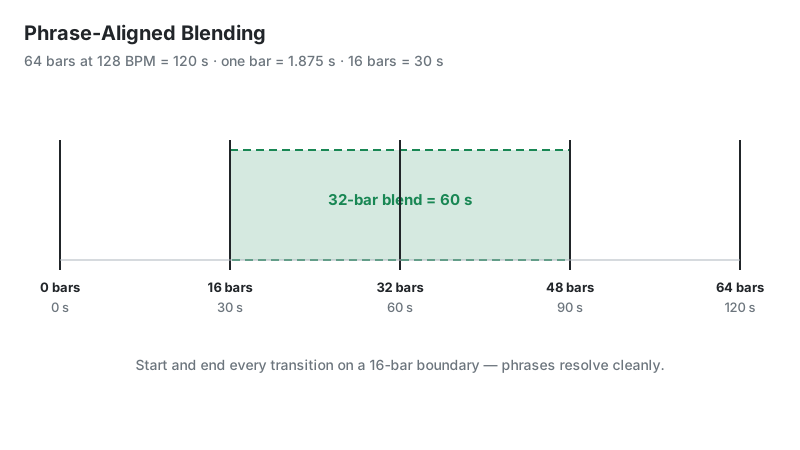
DJ software counts in bars; your instincts work in seconds. One 4/4 bar = 240 ÷ BPM seconds — 1.875 s at 128 BPM, 2 s at 120, 1.38 s at 174. Multiply by your bar count: a 16-bar blend at 124 BPM is 16 × 1.935 = 31 seconds.
| Tempo | 8 bars | 16 bars | 32 bars | 64 bars |
|---|---|---|---|---|
| 120 BPM | 16 s | 32 s | 64 s | 128 s |
| 128 BPM | 15 s | 30 s | 60 s | 120 s |
| 174 BPM | 11 s | 22.1 s | 44.1 s | 88.3 s |
Why it matters: transitions should start and end on phrase boundaries — multiples of 16 bars in most electronic music, where new elements enter. A 32-bar blend started mid-phrase sounds wrong no matter how perfect the math is. Count phrases (groups of 4 bars × 4), start the incoming track at a phrase start, and let the bar math tell you when you'll be fully mixed.
Transition Type Picker: Match Technique to the Gap
| BPM gap | Key verdict | Best technique |
|---|---|---|
| 0–3 BPM | Perfect / Good | Long blend (16–32 bars) — the money mix |
| 4–6 BPM | Any | Key lock on, medium blend or filter-sweep transition |
| 7–10 BPM | Any | Short blend, breakdown cover, or echo-out |
| 10+ BPM | Any | Cut/drop mix, echo out, or bridge track |
| 2:1 ratio | Any | Half/double-time blend — no pitch change (the calculator flags the raw gap as 10+ BPM; trust your ears) |
When in doubt, cut instead of blend. A confident drop-cut on the one beats a 64-bar blend that slowly goes wrong. Long blends are for compatible tracks; everything else gets a decisive transition.
The Energy Mismatch Trap
Perfect BPM and key math can't save an energy mismatch. Blending a peak-time track into a deep warm-up groove — identical tempo, compatible keys — clears floors because the energy curve breaks. Program in arcs: build for 20–30 minutes, peak, release, rebuild. The calculator solves the technical transition; only track selection solves the musical one.
Practical rule: never drop more than two energy levels in one transition (on a 1–10 scale). If you must reset the room, do it decisively with a full stop or an acapella — a slow fade into low energy sounds like the party dying.
Limitations
- Keys are detected, not guaranteed. Independent accuracy tests (bascurtiz's comparisons of key-detection tools, published by Digital DJ Tips) put auto-detected key accuracy between roughly 43% and 77% depending on the tool — trust your ears over the readout on unfamiliar tracks.
- The key check ignores your pitch move. It scores the codes you enter; with key lock off and a wide pitch move, the sounding key shifts — use the semitone readout to stay honest.
- Assumes 4/4 time. Broken beat, 3/4, and mixed-meter tracks need manual phrase counting.
- Numbers aren't music. EQ, phrasing, and energy decide whether a transition works; the math clears the technical path.
Transition Planning vs Alternatives
| Method | Precision | Use when |
|---|---|---|
| This calculator | Exact pitch % and timing | Planning blends, checking key compatibility |
| Sync button | Automatic | Live beatmatching when you trust the grid |
| Ear only | Variable | Experienced DJs; develops irreplaceable feel |
| BPM to Speed math | Exact ratios | Understanding the underlying tempo change |
Calculate the plan here, then execute by ear. The numbers say +3.2% is safe; only listening says the blend works.